


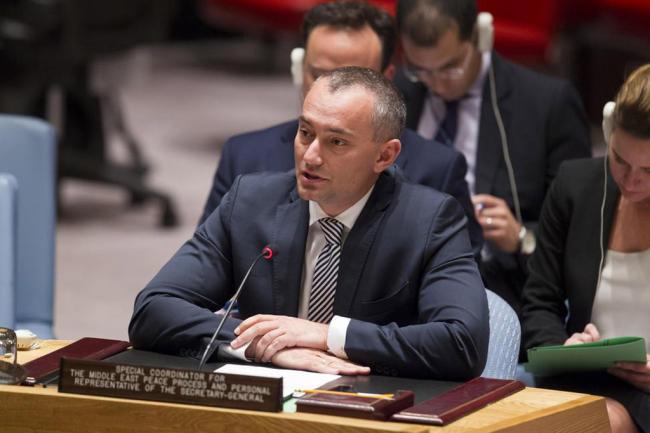
Security Council: UN official warns Middle East status quo not tenable
“The inability to respond, for over 60 years, both on the legitimate aspirations of the Palestinian people for a state and to Israel’s quest for security, has fuelled a situation that is becoming more dangerous by the day,” UN Special Coordinator for the Middle East Peace Process Nickolay Mladenov told the Security Council on Tuesday afternoon.
“This hard-earned belief in peace and negotiations must not be allowed to wither away,” he added.
He said, “If it does, it can further destabilize the Middle East for decades.”
Mladenov noted that thousands of people had died across the region so that one truth could emerge from the haze of conflict: “peace cannot be achieved through violence, but at the negotiating table.”
Nevertheless, he remains deeply concerned about the advancement of settlement activities in East Jerusalem and the West Bank over the past month and he urged the 15-member Council to have “no illusions about the impact of these unilateral actions,” which could only further destabilize a political and security climate already exacerbated by ongoing violence between Palestinians and Israeli security forces.
Turning to the situation in Gaza, meanwhile, the UN official recalled his initial “shock” during his first tour of the enclave devastated by last summer’s 51-day conflict between Israel and local militant group, Hamas.
According to a recent UN assessment, over 100,000 homes were damaged or destroyed in Gaza during the brief but intense fighting which ultimately affected more than 600,000 people and killed more than 2,100 Palestinians and more than 70 Israelis.
Today, many Gazans still lack access to the municipal water network. Blackouts of up to 18 hours per day are common.
“No one can remain untouched by the scale of devastation, the slow pace of reconstruction, and the vast needs to rebuild lives and livelihoods,” Mladenov continued, while also highlighting the positive developments in the UN’s ongoing efforts to assist in Gaza’s reconstruction.
He emphasized that Gaza remained “desperate and angry” at its forced isolation, imposed by the ongoing blockade, the closure of the Rafah border crossing, at Hamas’ imposition of a so-called solidarity tax, and at donors for “not honouring their financial commitments for reconstruction.”
“There is a clear moral and humanitarian imperative not just for the United Nations and the international community, but primarily for the Israeli and Palestinian authorities to prevent the implosion of Gaza,” he said.
Beyond that, he underscored the need to support any and all efforts to establish one Palestine which unifies Gaza and the West Bank through legitimate institutions amid a favourable economic climate in which the movement of people and goods is permitted and border crossings are reopened.
“The United Nations has repeatedly warned that maintaining the status quo is not tenable,” Mladenov concluded.
He lastly added, “It will inexorably lead to the continued erosion of living conditions for Palestinians and Israelis alike, and will undermine the security and stability for all.”
Concerning Lebanon, he said that, as of 25 May, the country would have been without a President for one year, which jeopardized the functioning of State institutions.
With 1.2 million registered Syrian refugees forming the highest per capita concentration of refugees in the world, he urged the international community to fulfil existing pledges, and to both increase and expedite support to Lebanon.
He said the shared border with Syria had been impacted by “infiltration” attempts by armed extremists, particularly as a result of fighting in the Qalamoun region.
Against that backdrop, Lebanon had received its first shipment of military equipment from France on 20 April, financed by a $3 million grant from Saudi Arabia, which he called a necessary and welcome contribution.
Finally, in the Golan, he described clashes between the Syrian Armed Forces and armed opposition members, as well as heavy fighting among armed groups in the area of separation, stressing that such developments had the potential to jeopardize the ceasefire between the two countries.
Photo: UN Photo/Loey Felipe
Support Our Journalism
We cannot do without you.. your contribution supports unbiased journalism
IBNS is not driven by any ism- not wokeism, not racism, not skewed secularism, not hyper right-wing or left liberal ideals, nor by any hardline religious beliefs or hyper nationalism. We want to serve you good old objective news, as they are. We do not judge or preach. We let people decide for themselves. We only try to present factual and well-sourced news.
Support objective journalism for a small contribution.


