


Security Council: UN envoy cites hope for Afghan peace process
By a resolution adopted unanimously by the 15-member Council, the UN Assistance Mission in Afghanistan (UNAMA) will remain in the country until 17 March 2016 to lead and coordinate international civilian efforts there.
The Council took that action while taking into account the completion of the transition process in Afghanistan and the initiation of the Transformation Decade (2015-2024).
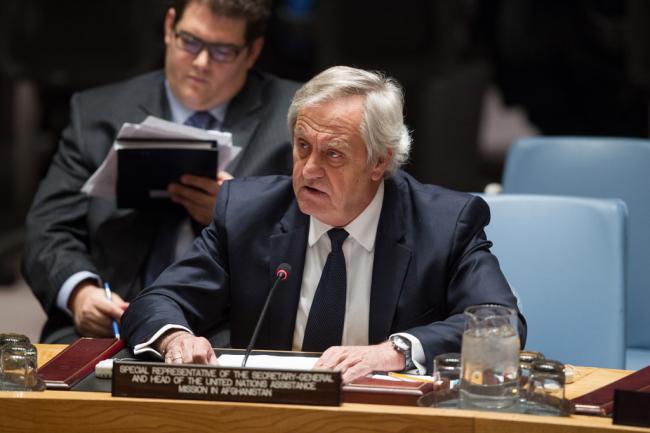
In his briefing to the Council, Nicholas Haysom, the Secretary-General’s Special Representative and head of UNAMA, pointed to a number of “significant developments” that had brought renewed hope for an active peace process, including the formation of a National Unity Government, together with constructive dialogue between Afghanistan and Pakistan.
“These positive developments are testament to the efforts of President Ashraf Ghani and Chief Executive Abdullah Abdullah,” he said.
“Their collaborative leadership will remain essential for any peace talks to progress, for comprehensive electoral reforms to take hold, and for the implementation of the changes required to reinvigorate the economy.”
Haysom urged political leaders to conclude the appointment of senior Government officials and to strengthen efforts to reinforce the rule of law and the fight against corruption.
He also noted the recent reports of possible peace talks between the Government and the Taliban.
“There is currently an alignment of circumstances that could be conducive to build a level of trust that will allow them to establish common ground,” he said, hoping parties can “come to the realisation that peace is the only viable option for Afghanistan, and that a military victory is neither likely, nor optimal for a lasting national social compact.”
The peace process was likely to remain “fragile and vulnerable to external destabilisation,” he warned.
Haysom called for coherent and coordinated international support while pointing to the continued “frank dialogue” between UNAMA and the Taliban on humanitarian access and on human rights, notably the protection of civilians.
A key part of the political agreement that led to formation of the National Unity Government was the pledge to establish an Electoral Reform Commission, and he welcomed President Ghani’s commitment to comprehensive reforms, which he said were essential to restoring the faith of the Afghan people in the democratic process and strengthening political stability.
Haysom also underlined the importance of regional cooperation and of proper intra-Afghan peace dialogue, which he said would require strong regional backing, and noted that the country’s economy remained a “significant concern,” with support needed for implementation of the Government’s Self-Reliance agenda.
He re-stated concerns about civilian casualties and noted persistent high levels of torture and ill-treatment of conflict-related detainees in Government detention facilities but added that recent military operations in Helmand and Kunar provinces demonstrated that the Afghan National Security Forces (ANSF) had improved their planning and operational capacity.
“They are now in a position to conduct large-scale operations without direct combat assistance from international military forces,” he said.
He added, “This development is encouraging even though we expect to see an intensification of combat in the upcoming fighting season as insurgents seek to test the ANSF capacity to hold ground on their own.”
Photo: UN Photo/Loey Felipe
Support Our Journalism
We cannot do without you.. your contribution supports unbiased journalism
IBNS is not driven by any ism- not wokeism, not racism, not skewed secularism, not hyper right-wing or left liberal ideals, nor by any hardline religious beliefs or hyper nationalism. We want to serve you good old objective news, as they are. We do not judge or preach. We let people decide for themselves. We only try to present factual and well-sourced news.
Support objective journalism for a small contribution.


