


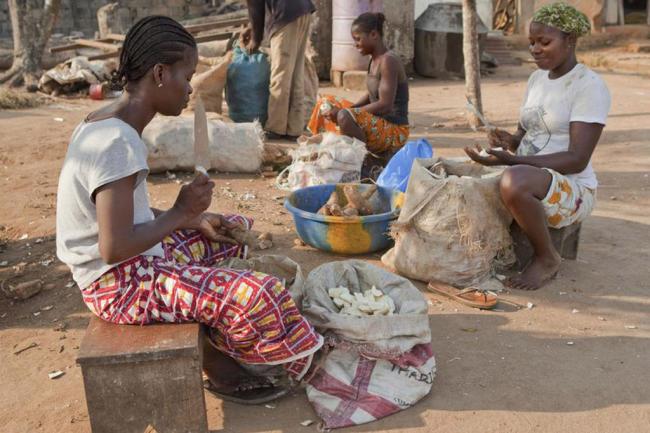
Rural women are the backbone of sustainable livelihoods: Ban
“They are farmers and farm workers, horticulturists and market sellers, business women and community leaders. Rural women are the backbone of sustainable livelihoods and provide food security for their families and communities,” said UN Secretary-General Ban Ki-moon in his message marking the occasion.
Ban also noted that the International Day falls just after the adoption of the 2030 Agenda for Sustainable Development last month. He urged the global leaders to seize the opportunity offered by the new framework to transform rural women’s lives.
“The new Sustainable Development Goals (SDGs) have gender equality and women’s empowerment at their core, and include a target to “double the agricultural productivity and incomes of small-scale food producers, in particular women.” Indeed, rural women are critical to the success of almost all the 17 SDGs,” said Ban.
“We must build resilient social protection systems, labour and product markets, governance institutions, and civil society organizations so that rural women can both contribute to and benefit from sustainable development,” said the Secretary-General.
The sentiment was shared by UN Women Executive Director Phumzile Mlambo-Ngcuka who also reaffirmed that rural women play a key role in underpinning sustainable development and further stressed that following the framework of Agenda 2030 will help in accelerating progress for rural women.
“As we launch Agenda 2030 globally and locally, we must learn from the lessons of implementing theBeijing Platform for Action and the Millennium Development Goals (MDGs). We have an unparalleled opportunity and commitment to end poverty and hunger, achieve food and nutrition security, and guarantee sustainable livelihoods by investing in rural women and climate-resilient agriculture,” said Mlambo-Ngcuka.
However, according to MDG indicators, rural women suffer disproportionately from poverty, and face multiple forms of discrimination, violence and insecurity as compared to rural men and urban men and women.
Mlambo-Ngcuka observed that at the Global Leaders’ Meeting on Gender Equality and Women’s Empowerment: A Commitment to Action, the top political leaders of Angola, Colombia, Jordan, Paraguay, Senegal and Viet Nam highlighted intersecting forms of discrimination for girls and women living in poverty in rural areas.
“They include economic and financial barriers to girls’ education such as the elimination of school fees and provision of stipends, scholarships and non-financial support, particularly in rural and remote areas. Legal reforms are needed to guarantee women’s equal right to property and to realize sexual and reproductive health and rights,” added the Executive-Director.
She urged to address these barriers to rural women’s progress with measures that are compliant with the Agenda 2030.
She also stressed on increasing access to healthcare, provision of free or subsidized essential drugs and commodities, access to family planning measures and upgrading their skills through agricultural extension services.
Highlighting the role women can play in addressing climate change activities, the Executive-Director reported that in Bangladesh, targeted steps are being taken with 19,000 women, to prepare for its known vulnerability to climate change.
“Women’s participation in local institutions for governing natural resources is critical for sustainable land, forest and water management, as well as for building resilience and planning for climate change and adaptation strategies,” said Mlambo-Ngcuka.
“Addressing the adverse effects of climate change through climate-resilient agriculture strategies and natural resource management is increasingly important for securing rural women’s rights, empowerment, and well-being,” she added.
Although women constitute 43 percent of the agricultural labour force in developing countries, many of them are without ownership of the lands they work in and neither do they have an authoritative voice in local governments.
Mlambo-Ngcuka stressed that this can only be changed if the global leaders take every opportunity to ‘ensure that rural women do not lag behind, but rather lead the way.’
“The International Day of Rural Women is an opportune moment to amplify rural women’s voices and experiences from around the globe. Let us act on our commitment to creating opportunities for rural women across every relevant goal – and thereby advance progress for all,” added Ban.
UN Photo/Patricia Esteve
Support Our Journalism
We cannot do without you.. your contribution supports unbiased journalism
IBNS is not driven by any ism- not wokeism, not racism, not skewed secularism, not hyper right-wing or left liberal ideals, nor by any hardline religious beliefs or hyper nationalism. We want to serve you good old objective news, as they are. We do not judge or preach. We let people decide for themselves. We only try to present factual and well-sourced news.
Support objective journalism for a small contribution.


