


 Nobel Prize
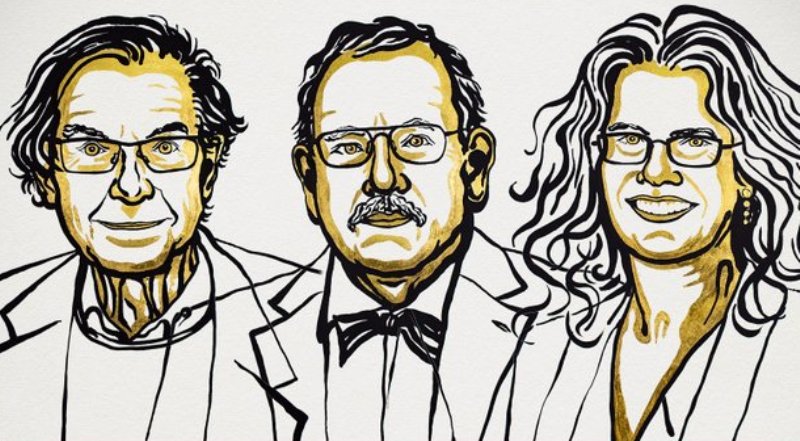
Roger Penrose, Reinhard Genzel and Andrea Gheza awarded Nobel Prize for Physics for research in black hole
The 2020 Nobel Prize for physics was awarded to scientists Roger Penrose, Reinhard Genzel and Andrea Gheza on Tuesday.
They were awarded for their research on black holes.
"Three Laureates share this year’s Nobel Prize in Physics for their discoveries about one of the most exotic phenomena in the universe, the black hole," read the official website of the Nobel Prize.
Roger Penrose showed that the general theory of relativity leads to the formation of black holes.
Reinhard Genzel and Andrea Ghez discovered that an invisible and extremely heavy object governs the orbits of stars at the centre of our galaxy.
A supermassive black hole is the only currently known explanation.
Roger Penrose used ingenious mathematical methods in his proof that black holes are a direct consequence of Albert Einstein’s general theory of relativity. Einstein did not himself believe that black holes really exist, these super-heavyweight monsters that capture everything that enters them. Nothing can escape, not even light.
In January 1965, ten years after Einstein’s death, Roger Penrose proved that black holes really can form and described them in detail; at their heart, black holes hide a singularity in which all the known laws of nature cease. His groundbreaking article is still regarded as the most important contribution to the general theory of relativity since Einstein.
Reinhard Genzel and Andrea Ghez each lead a group of astronomers that, since the early 1990s, has focused on a region called Sagittarius A* at the centre of our galaxy.
The orbits of the brightest stars closest to the middle of the Milky Way have been mapped with increasing precision.
The measurements of these two groups agree, with both finding an extremely heavy, invisible object that pulls on the jumble of stars, causing them to rush around at dizzying speeds. Around four million solar masses are packed together in a region no larger than our solar system.
Using the world’s largest telescopes, Genzel and Ghez developed methods to see through the huge clouds of interstellar gas and dust to the centre of the Milky Way.
Stretching the limits of technology, they defined new techniques to compensate for distortions caused by the Earth’s atmosphere, building unique instruments and committing themselves to long-term research.
Their pioneering work has given us the most convincing evidence yet of a supermassive black hole at the centre of the Milky Way.
“The discoveries of this year’s Laureates have broken new ground in the study of compact and supermassive objects. But these exotic objects still pose many questions that beg for answers and motivate future research. Not only questions about their inner structure, but also questions about how to test our theory of gravity under the extreme conditions in the immediate vicinity of a black hole”, says David Haviland, chair of the Nobel Committee for Physics.
Support Our Journalism
We cannot do without you.. your contribution supports unbiased journalism
IBNS is not driven by any ism- not wokeism, not racism, not skewed secularism, not hyper right-wing or left liberal ideals, nor by any hardline religious beliefs or hyper nationalism. We want to serve you good old objective news, as they are. We do not judge or preach. We let people decide for themselves. We only try to present factual and well-sourced news.
Support objective journalism for a small contribution.


