


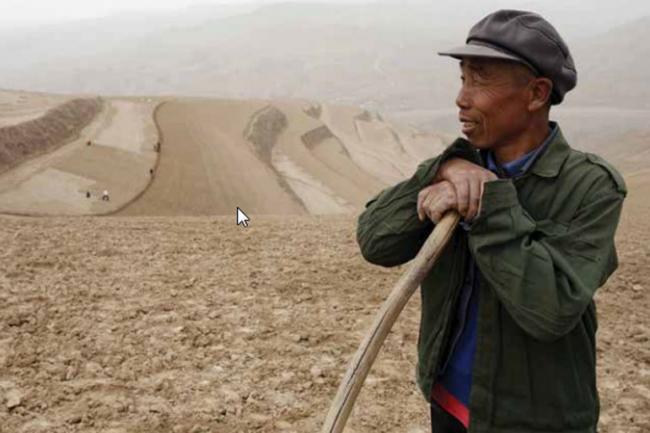
Rehabilitating drylands key to global food security, according to new UN report
“Drylands are absolutely key to global food security for the whole planet,” said IFAD President, Kanayo F. Nwanze in a press release on the report, which was launched on Friday in Marrakech, Morocco, where the 22nd Conference of Parties to the UN Framework Convention on Climate Change (UNFCCC), known as COP 22, has been under way since Monday.
“Environment friendly and water efficient agriculture for smallholders is key to reducing poverty, boosting smallholder adaptation to climate change, and rehabilitating degraded lands. We look to empower more rural farmers to sustainably manage their land, so that while they feed their families for generations to come, they can also get out of poverty,” he said.
Drylands typically refer to arid, semi-arid, and dry sub-humid areas. They are present on every continent and are home to more than two billion people. They support up to 44 per cent of the world’s cultivated agricultural systems.
The report, The Drylands Advantage: Protecting the environment, empowering people, explains how drylands support ecosystems and a wide variety of biodiversity as well as their vital role in the livelihoods and cultural identities of many people.
In Swaziland, for example, IFAD has supported communities in rehabilitating gullied land and introducing sustainable land management practices for 68,000 hectares of land – thus generating a new source of livelihoods for the people who live there.
In China’s Yanchi county, where drylands are becoming deserts, farmers have increased their incomes by 20 per cent thanks to a programme which generates alternative and sustainable livelihoods. Without it, desertification would likely worsen and drylands would be non-arable.
IFAD backs projects that both help smallholders thrive in drylands and contribute to the UN Sustainable Development Goals (SDGs) through the 2030 Agenda – particularly to “protect, restore and promote sustainable use of terrestrial ecosystems, sustainably manage forests, combat desertification, and halt and reverse land degradation and halt biodiversity loss.”
However, Margarita Astralaga, Director of IFAD’s Environment and Climate Division, warns that “despite their importance, drylands are being degraded with enormous economic consequences.”
“Desertification of drylands could lead to some 50 million people being displaced within the next 10 years,” she said.
But IFAD’s investments are proving promising: “By investing in drylands, IFAD is seeing significant human and environmental dividends. Environment-friendly and water-efficient agriculture for smallholders is key to reducing poverty, boosting smallholder adaptation to climate change, as well as rehabilitating degraded lands.”
Photo: IFAD/Qilai Shen
Source: www.justearthnews.com
Support Our Journalism
We cannot do without you.. your contribution supports unbiased journalism
IBNS is not driven by any ism- not wokeism, not racism, not skewed secularism, not hyper right-wing or left liberal ideals, nor by any hardline religious beliefs or hyper nationalism. We want to serve you good old objective news, as they are. We do not judge or preach. We let people decide for themselves. We only try to present factual and well-sourced news.
Support objective journalism for a small contribution.


