


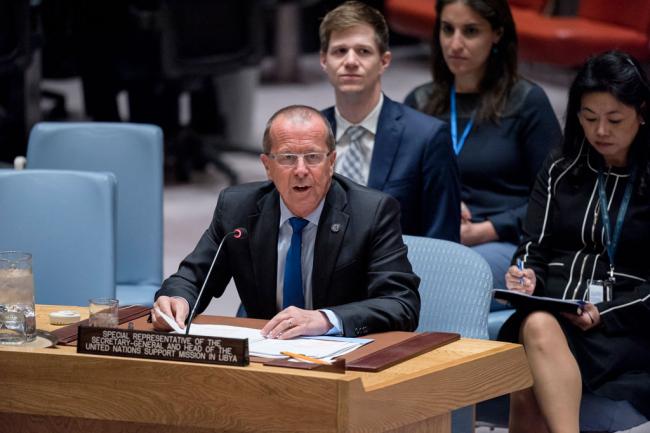
Political momentum must be renewed if Libya’s challenges are to be addressed – UN envoy
In his briefing to the Council, Martin Kobler, the Special Representative of the Secretary-General for Libya, said that the majority of Libyans and the international community continued to strongly support the political agreement and its institutions and recognized the Presidency Council as the sole national executive authority.
“Both Libyans and the international community support the Agreement. Yes, it can be amended. But no, there is no alternative, there is no ‘plan B.’ And there is no need for one,” he said, underscoring: “If the parties do not uphold their responsibility in the Libyan Political Agreement, there is no reason to think that they will have any greater commitment to an alternative agreement.”
Turning to the many other signs of positive developments in the country, including recent developments in the fight against terrorism and the improvement of the security situation in Tripoli, Kobler said that on the economic front, Libyan wages are on the rise and oil production has increased.
Despite progress, uncertainty contributing to ‘dangerous political power vacuum’
But the optimism generated by the signing of the Agreement has diminished, reported Kobler, emphasizing that instead of the “sharp horizon” established by the Agreement he now sees instead “frustration, disappointment, sometimes anger, and often it is justified.” He cited rising criminality, which remains widespread throughout the country, the division of institutions and the lack of guarantee of public services for the population.
The country's gross domestic product (GDP), he added, has been steadily declining since 2012, not to mention the persistence of the parallel economy and illegal activities.
Kobler regretted that the current political vacuum is hampering efforts to create a united security force, to the point where some actors are considering a return to a military solution. “Competition for the control of national resources risks generating new violence,” he said, adding: The results of these divisions are setting Libya on a worrying path. Public services, including access to electricity, health, education, water, are failing many.”
Against this backdrop, he said the time has come to return to the negotiating table and “regain the spirit of Skhirat,” referring to the seaside Moroccan town where the deal was reached. For this, he said, the country needs a strong international support, not only from an institutional point of view. He thus defended the creation of partnerships with Libyan society.
Seven steps to peace
With all this in mind, Kobler called on all political actors to agree on a fair and inclusive process to amend the political agreement. Secondly, he called for an immediate end to violence, including in the south of the country, as well as establishing unified security and confidence-building measures. In this regard, he said, the Committee responsible for supervising the ceasefire in Tripoli is an excellent starting point.
He went on to call for improving cooperation between the Presidency Council and all the economic players. The UN Support Mission in Libya (UNSMIL), which he heads up, should help them to do so, he said.
Finally, the Special Representative called on the international community, including the UN, regional organizations and neighbouring States, not only to react after the fact but to anticipate the Libyan problems.
UN Photo/Rick Bajornas
Source: www.justearthnews.com
Support Our Journalism
We cannot do without you.. your contribution supports unbiased journalism
IBNS is not driven by any ism- not wokeism, not racism, not skewed secularism, not hyper right-wing or left liberal ideals, nor by any hardline religious beliefs or hyper nationalism. We want to serve you good old objective news, as they are. We do not judge or preach. We let people decide for themselves. We only try to present factual and well-sourced news.
Support objective journalism for a small contribution.


