


 PoK Unrest
Pakistan's 'Nepal Moment'? PoK on boil again as Gen Z takes to streets against govt
Islamabad/IBNS: Pakistan-occupied Kashmir (PoK) is in turmoil once again — its second major wave of unrest in just a month — this time driven by students and Gen Z activists.
What began as a routine campus protest over rising university fees and flawed exam results has quickly morphed into a broader, politically charged uprising targeting both the Shehbaz Sharif government and Pakistan’s powerful military establishment.
How the student protests erupted
The latest wave of demonstrations erupted earlier this month at the University of Azad Jammu & Kashmir (UAJK) in Muzaffarabad.
Students initially mobilised against steep fee increases and major discrepancies in examination results following the rollout of a new digital evaluation system, commonly referred to as “e-marking,” for matriculation and intermediate levels.
When the intermediate first-year exam results were finally released after a six-month delay, thousands of students were left shocked and angry.
🚨 Chaos in PoK :-
— THE UNKNOWN MAN (@Theunk13) November 4, 2025
Shots fired during student protests — arson and vandalism reported in several areas.⚡ The core issues behind the university students’ demonstrations:Lack of transportation, deteriorating hospitals, and continuously rising university fees -prompting students… pic.twitter.com/9JVyKdSZFA
Many claimed they were given inexplicably low marks, while others discovered they had been marked as having passed subjects they never even took.
Amid mounting outrage, the Board of Intermediate and Secondary Education in Mirpur announced the formation of a committee to investigate the irregularities.
But the damage was already done. The government’s decision to impose rechecking fees of Rs 1,500 per subject — a heavy burden for most families in the region — only inflamed public anger further.
The university administration, however, rejected the allegations. According to a statement cited by Kashmir Digital, UAJK denied reports of a 60% fee hike, describing them as “false and baseless.”
Officials insisted that only a 10% annual increase had been implemented as per existing regulations, and a proposed Rs 1,000 rise in transport fees, which had not yet been approved, was promptly withdrawn following backlash.
1/4 GenZ Protests in #Pakistan Occupied #Kashmir
— The Wonk (@thewonkin) November 5, 2025
Students & Gen Z in PoK and Pakistan are protesting fee hikes, unfair policies, #Unemployment & governance failures
From Muzaffarabad to Mirpur, call for PoK to join #India #spoilthevote #GenZProtest #sstvi #POK #BabarAzam pic.twitter.com/inrNtv8tPe
In the same communication, the university announced the suspension of classes at its Chella campus, citing “security concerns for students, faculty, and staff,” and urged police to take legal action against those involved in the violence.
Despite these clarifications, demonstrations intensified.
Students continued to gather across campuses, denouncing the administration for poor infrastructure, inadequate transport, and bureaucratic neglect.
What started as an agitation over educational grievances quickly snowballed into a wider protest movement — one that has come to symbolise public frustration with corruption, unemployment, and systemic misgovernance in PoK.
Violence in Muzaffarabad
The protests took a violent turn when gunfire broke out at one of the demonstration sites, injuring a student.
Eyewitness accounts published by Kashmir Digital alleged that a man identified as Raja Mamoon Fahad opened fire on the crowd before escaping.
The incident, they claimed, occurred within sight of local police officers, even though the Sadar police station is located mere metres from the campus.
Videos showing the chaos and panic spread rapidly across social media, galvanising more students and drawing widespread condemnation.
From Subsidies to Sovereignty: The New Uprising in Muzaffarabad
— Pakistan-China Faultline Focus (@LineOfDeceit) October 28, 2025
What began as an economic protest in “Azad” Kashmir has now stripped away Pakistan’s biggest lie, that the people of PoJK are content under its rule.
Muzaffarabad: Thousands gathered in open defiance, declaring on… pic.twitter.com/49Dp1dSJg7
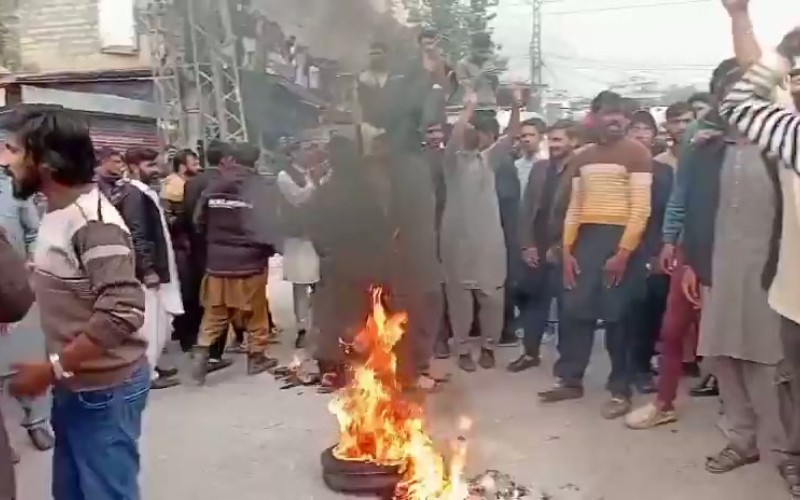
Enraged demonstrators blocked roads, set tyres ablaze, and chanted slogans denouncing both the Sharif government and the Pakistan Army.
Observers note that the situation in Muzaffarabad now echoes youth-led uprisings in Nepal, Bangladesh, and Sri Lanka, where frustrations over corruption, misgovernance, and elite impunity have sparked regime-threatening movements.
The parallels are not lost on Islamabad. Analysts warn that the ongoing protests could serve as a precursor to a larger wave of dissent against Pakistan’s ruling establishment.
Banning student unions: A crackdown on dissent?
In a controversial move, the UAJK administration responded by banning student unions and all political activities on campus, claiming it was necessary to restore order.
The decision, however, has been widely interpreted as an attempt to silence student activism and suppress dissent.
Reports indicate that India condemned the crackdown, calling it a blatant violation of fundamental freedoms.
Senior officials in New Delhi argued that the arrests, intimidation, and restrictions on political expression in PoK exposed the absence of civil liberties under Pakistan’s illegal occupation.
For many in the region, the bans are yet another reminder of Islamabad’s longstanding policy of political repression.
The protests, infused with anti-army slogans and open defiance of Pakistan’s authority, reflect a growing rejection of the state’s control over PoK — territory it has occupied since 1947 through military-backed tribal incursions into the princely state of Jammu and Kashmir.
Return of Joint Awami Action Committee
The Jammu and Kashmir Joint Awami Action Committee (JKJAAC) — a broad coalition of civil groups that spearheaded widespread protests in October — has now publicly aligned itself with the student demonstrators.
Just weeks earlier, PoK had witnessed large-scale unrest over economic grievances such as exorbitant electricity bills, high taxation, and the slow pace of development projects.
Those protests culminated in deadly clashes, with security forces firing on demonstrators and killing at least 12 civilians.
The violent outcome forced the Shehbaz Sharif government to engage in direct negotiations with the JKJAAC, leading to concessions on several of its demands.
The renewed alignment between student activists and the committee has reignited fears in Islamabad of a unified front of civil resistance emerging across the occupied territory.
Islamabad’s fear of a Gen Z-led uprising like Bangladesh, Nepal
The Sharif administration, along with Pakistan’s intelligence agencies, reportedly views the current protests with growing unease.
Their greatest concern lies in the demographic composition of the movement — young, digitally connected, and politically assertive.
The parallels with uprisings in Nepal and Bangladesh have become a recurring theme in Pakistan’s internal assessments, according to multiple reports.
9 youth died in the Gen_Z protest in Nepal against socialist government ban on 26 social media apps including Facebook, youtube and @X .
— Tulsi For President (@TulsiPotus) September 8, 2025
Youths demand complete change of leadership in the country most deaths are due to police firing. #Nepal #genznepal #genzie pic.twitter.com/XEuh6yk8ts
In Nepal, a youth-led movement initially protesting a social media ban evolved into a nationwide campaign that ultimately toppled Prime Minister KP Sharma Oli.
In Bangladesh, similar student and youth mobilisations in 2024 dismantled Sheikh Hasina’s long-standing regime, fuelled by anger over corruption and authoritarian rule.
Bangladeshi students have done it!!!!
— OurFaveOnlineDoc 🇬🇧 🇳🇬 (@OurFavOnlineDoc) August 5, 2024
They stormed the streets for an end to quota system appointments made by the govt.
The govt killed 94 protesters but the students stood their ground.
Today the prime minister resigned and ran away from the country!
pic.twitter.com/rthaOXcUdU
In both South Asian countries, what began as isolated grievances spiralled into sweeping anti-government movements — a pattern now unsettlingly familiar in PoK.
The protests there exhibit the same generational outrage, driven by frustration over unemployment, institutional decay, and state repression.
Research Fellow @NayanaPrakash1 (@CH_IntSecurity) discusses the ‘Gen Z protests’ that have taken place across the Global South in 2025 ⤵️ pic.twitter.com/NNNlekjRmN
— Chatham House (@ChathamHouse) November 7, 2025
Intelligence sources in Islamabad reportedly fear that the agitation could spread beyond PoK, tapping into the simmering resentment already visible in Balochistan and Khyber Pakhtunkhwa, two provinces long scarred by insurgency and neglect.
An unrest that may not remain contained
For now, the Sharif government has resorted to police crackdowns and media censorship to contain the growing dissent. Yet such tactics risk fuelling more anger.
Reports of arbitrary arrests and heavy-handed policing have only deepened the sense of alienation among students and young people.
Analysts warn that repeated crackdowns could transform these localised protests into a national movement, echoing the same dynamics seen in other South Asian nations where youth disillusionment became the catalyst for political upheaval.
Support Our Journalism
We cannot do without you.. your contribution supports unbiased journalism
IBNS is not driven by any ism- not wokeism, not racism, not skewed secularism, not hyper right-wing or left liberal ideals, nor by any hardline religious beliefs or hyper nationalism. We want to serve you good old objective news, as they are. We do not judge or preach. We let people decide for themselves. We only try to present factual and well-sourced news.
Support objective journalism for a small contribution.


