


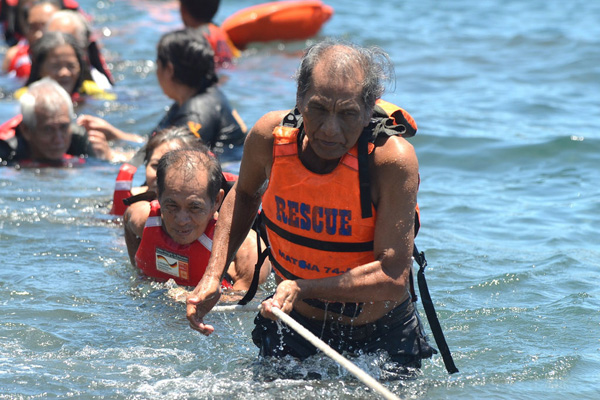
On World Disaster Reduction Day, UN spotlights unique needs, vulnerabilities of older persons
“This tragic trend must be reversed though plans, services and support,” said Secretary-General Ban Ki-moon in a statement commemorating the Day, organized by the UN Office for Disaster Risk Reduction (UNISDR), with this year’s theme focusing on “Older persons and disasters.”
“Disaster planning must take account of the reduced mobility experienced by many older persons…[Their] needs should also be taken into account in early warning systems, social protection mechanisms, evacuation and emergency response plans, and public awareness campaigns,” Ban added, in is message on the Day, marked annually on 13 October.
According UNISDR, there is strong evidence that older persons suffer disproportionately from disasters even in developed countries. In 2005, 75 per cent of those killed by Hurricane Katrina in the United States were over 60 but made up just 15 per cent of the population in New Orleans. In 2011, 56 per cent of those who died in the Great East Japan Earthquake and Tsunami were 65 and over, despite comprising just 23 per cent of the population.
The problem is even more pronounced in developing countries, where poverty affects some 80 per cent of those over 60. That means older persons frequently live in unsafe housing in high-risk areas and– for economic as well as physical reasons–cannot easily flee from disaster.
UNISDR chief, Margareta Wahlström said: “The older person is often invisible in our communities until they show up in the mortality figures after a disaster event.”
A UNISDR survey found that older persons are often excluded or marginalised when disaster management plans are being draw up at the community level. Asked how they would like to be better included in decision-making on disaster planning, 70 per cent of respondents said they would like to explain the special needs and vulnerabilities of older persons, while 43 per cent said they wish to be given training.
“The world needs to become more acutely aware of how to protect older persons as the climate changes…thousands of people die every year in heat waves and older persons living in poverty are among the most vulnerable,” said Wahlström.
On this Day, UNISDR in conjunction with HelpAge International is calling on governments to sign up toCharter 14, for Older People in Disaster Risk Reduction and commit to specific inclusion of older persons in all facets of disaster management planning.
The UN World Health Organization (WHO) is joining efforts to draw greater attention to the needs and vulnerabilities of older persons by urging countries to bolster their capacities.
“We’re unfortunately seeing a proliferation of many different types of crises in recent years,” said Rick Brennan, WHO’s Director of Emergency Risk Management and Humanitarian Response in a statement. “Hard experience shows us that older persons aren’t receiving the care and support they require.”
WHO recommends that special planning and sufficient attention for the elderly when natural catastrophes such as typhoons and earthquakes strike, or when violence uproots thousands and even millions, driving older persons from their homes and communities.
Other concrete action includes providing appropriate water-carrying containers, designing latrines in emergency shelters and camps so that they can be safely used by the elderly, such as by including handrails.
People aged over 60 currently make up slightly more than 11 per cent of the global population. By 2050, and they will account for 22 per cent of the population and number 2 billion.
According to the UN Office for Disaster Risk Reduction (UNISDR), there is strong evidence that older persons suffer disproportionately from disasters even in developed countries. Photo: COSE/Artemio Andaya
Support Our Journalism
We cannot do without you.. your contribution supports unbiased journalism
IBNS is not driven by any ism- not wokeism, not racism, not skewed secularism, not hyper right-wing or left liberal ideals, nor by any hardline religious beliefs or hyper nationalism. We want to serve you good old objective news, as they are. We do not judge or preach. We let people decide for themselves. We only try to present factual and well-sourced news.
Support objective journalism for a small contribution.


