


No evidence death penalty deters any crime: UN official
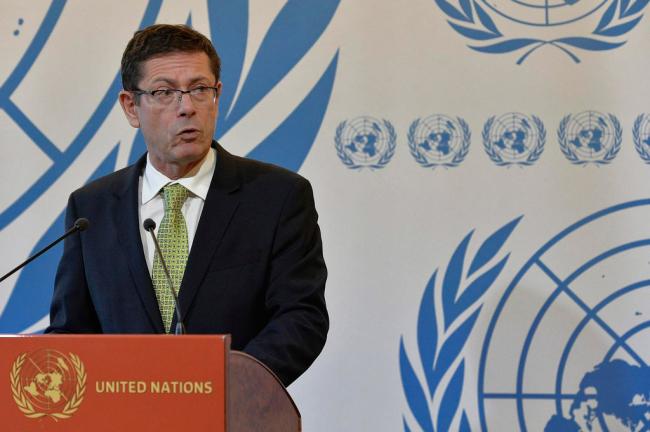
“We can do better. We need not kill immigrants, minorities, the poor and those with disabilities to show that we are committed to fight crime,” Ivan Šimonović, Assistant Secretary-General for Human Rights, said in his opening remarks to the UN Human Rights Council on the third day and final day of meetings.
The Council kicked off its three-day High-Level Segment on Monday. This is the 47-member body’s 28th session.
At this afternoon’s meeting on regional efforts aiming at the abolition of the death penalty and challenges faced, Šimonović underscored the need for a unified approach to the global abolition of what he called an “inhuman and outdated punishment.”
“Several countries continue to use the death penalty for drug-related crimes, with the argument that this harsh punishment is needed for deterrence purposes. However, there is no evidence that the death penalty deters any crime,” he emphasized in his remarks.
The Americas were the first to abolish the death penalty in Venezuela in 1867. Following that, many other countries in the region abolished the death penalty leading to the 1990 adoption of the Protocol to the Inter-American Convention on Human Rights.
In Africa, many States have taken an abolitionist stance. Meanwhile, in the past sixteen years, no death sentence has been carried out in any of the 47 member States of the European Union.
And in the Middle East and Asia, national human rights institutions and civil society are moving the abolitionist movement forward.
As it stands now, some 160 countries have either fully abolished the death penalty or do not practise it. In the last six months, the death penalty was abolished in Chad, Fiji, and Madagascar.
However, despite these strides some countries are seeing a move towards the preservation and even reintroduction of the death penalty, said Šimonović, pointing out that in 2013, there were more executing States and more victims of execution than in 2012.
“Some States justify the death penalty on the grounds that it is demanded by a large majority of the population, or that without it, it is impossible to fight drug trafficking or terrorism,” he added.
While the need to tackle drug-related offences has to be acknowledged, the focus of crime prevention should be on strengthening the justice systems and making it more effective.
And while public opinion cannot be ignored, a country concerned with human rights should not merely accept opinion polls as a reason for retaining the death penalty.
“Indeed, there is clear evidence of mistakes, abuses and discrimination. It has been empirically proved that the more the population is informed on facts, the less it supports the death penalty, " he added.
In recognition of the crucial role that regional organisations play in promoting the abolition of the death penalty, the Office of the UN High Commissioner for Human Rights (OHCHR) plans to hold several regional seminars on moving away from the death penalty this year.
“We hope to gather State officials, lawmakers, practitioners and civil society to discuss at the regional level the challenges aced in moved away from the death penalty and ways to overcome them,” Šimonović said.
Photo:UN Photo/Jean-Marc Ferré
Support Our Journalism
We cannot do without you.. your contribution supports unbiased journalism
IBNS is not driven by any ism- not wokeism, not racism, not skewed secularism, not hyper right-wing or left liberal ideals, nor by any hardline religious beliefs or hyper nationalism. We want to serve you good old objective news, as they are. We do not judge or preach. We let people decide for themselves. We only try to present factual and well-sourced news.
Support objective journalism for a small contribution.


