


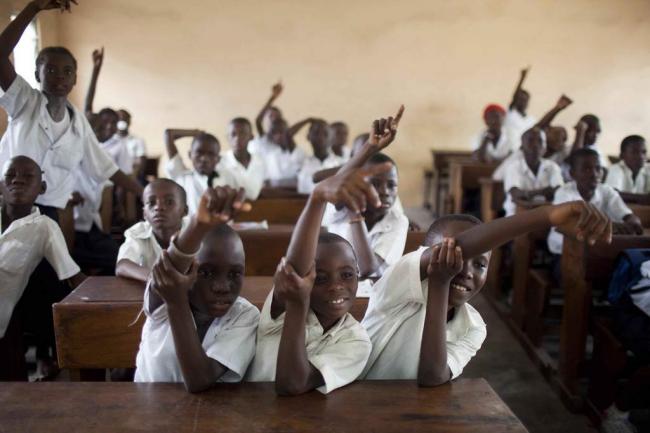
New UN study estimates 263 million childrenand youth now out of school
“Countries have promised to provide every child with a primary and secondary education by 2030. These new findings show the hard work ahead if we are to reach this goal,” said UNESCO Director-General Irina Bokova.
“Our focus must be on inclusion from the earliest age and right through the learning cycle, on policies that address the barriers at every stage, with special attention to girls who still face the greatest disadvantage.”
A new paper, Leaving no one behind: How far on the way to universal primary and secondary education?, released jointly by the agency's Institute for Statistics and the Global Education Monitoring (GEM) Report, finds that the total number includes about 61 million children of primary school age (6-11 years), 60 million of lower secondary age (12-14 years), and about 142 million of upper secondary school age (15-17 years). This is the first-ever study to estimate of those at the secondary school age.
Sub-Saharan Africa, with the lowest numbers, had over a fifth of children of primary school age, followed by a third of youths in the lower secondary age, and almost 60 per cent of youths in the upper secondary age out of schools.
Persistent disparities in education participation linked to sex, location and wealth, as well as armed conflict were noted in the paper as major barriers to education. Globally, 35 per cent (22 million) of all out-of-school children of primary education age, 25 per cent of all adolescents of lower secondary age (15 million), and 18 per cent (26 million) of all out-of-school youths of upper secondary age live in areas affected by conflict.
It further noted that, in general, 15 to 17-year-olds are four times as likely to be out of school as are children aged 6 to 11, partly because primary and lower secondary education are compulsory in nearly every country, while upper secondary school is not.
“At the same time, these youths are often of legal working age. Many have no choice but to work while others try to combine going to school with employment,” said the statement.
Girls more likely than boys to never set foot in a classroom
The paper also found that despite efforts made and progress achieved over the past two decades, 15 million girls of primary school age will never get the chance to learn to read or write in primary school compared to about 10 million boys. Over half of these girls, some nine million, live in sub-Saharan Africa.
It noted that poverty creates an additional barrier for girls. In Northern Africa and Western Asia, according to the GEM Report's analysis, gaps are far wider among the poorest in the region. Only 85 girls for every 100 boys of lower secondary school age attend school. Among those of upper secondary school age, only 77 of the poorest girls for every 100 of the poorest boys attend.
Photo: World Bank/Dominic Chavez
Source: www.justearthnews.com
Support Our Journalism
We cannot do without you.. your contribution supports unbiased journalism
IBNS is not driven by any ism- not wokeism, not racism, not skewed secularism, not hyper right-wing or left liberal ideals, nor by any hardline religious beliefs or hyper nationalism. We want to serve you good old objective news, as they are. We do not judge or preach. We let people decide for themselves. We only try to present factual and well-sourced news.
Support objective journalism for a small contribution.


