


New letters by Indian Muslim soldiers from WW1 disclosed
Dr Islam Issa, Lecturer in English Literature at Birmingham City University, previously found that at least 885,000 Muslims were recruited by the Allies, having trawled through thousands of personal letters, historic archives, regimental diaries and census reports.
New personal letters discovered by Dr Issa from over 100 years ago, highlight the experiences of Indian soldiers as they share their impressions of England in comparison to their home country.
Commenting on the police in a letter dated October 1915, A. Ali said: “The police indeed deserve praise. If one policeman raises his hand every single person in that direction rich and poor alike, stands still where he is as long as his hand is raised.”
On his trip to a London department store, A. Ali said: “We visited a shop where 2000 men and women were working and everything can be bought. There is no need of asking as the price is written on everything.”
In the same letter, he shares his experience of the London Underground. “Then we went in the train that goes under the earth, it was for us a strange and wonderful experience – they call it the underground train”, he said.
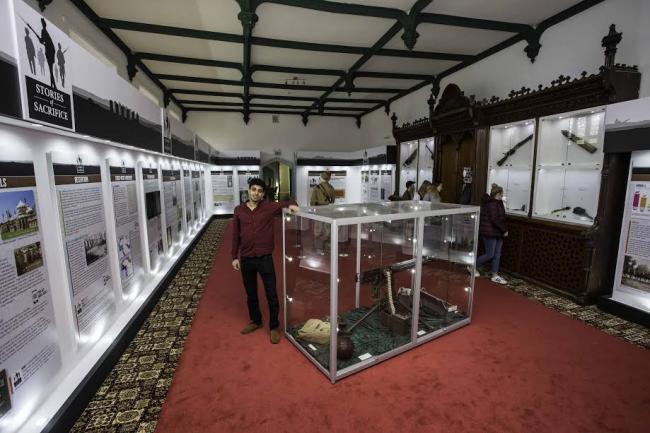
Dr Issa has been researching individual stories from the Great War for an exhibition commissioned by and held at the British Muslim Heritage Centre in Manchester, called ‘Stories of Sacrifice’.
In another 1915 letter by Abdul Said, more opinions on shopping and butchers are shared. “Every shop in this country is so arranged that one is delighted to look at them. Whether you buy much or little it is properly wrapped up, and if you tell the shop man to send it to your house you have only to give him your address and he delivers it.
“The butcher’s shops in Hindustan are very dirty, but here they are so clean and tidy that there is absolutely no smell.”
During his research, Dr Issa found that 1.5 million Indians and 280,000 Algerians, Moroccans and Tunisians fought for the Allies during the First World War, as well as soldiers recruited from other parts of Africa.
“When I decided to look at soldiers’ letters, I expected a very bleak outlook on the war. Of course, sometimes, that’s exactly what I found. But quite often, the letters were about individual experiences and very normal, human things”, said Dr Issa.
“These anecdotes certainly helped shape my narrative for the ‘Stories of Sacrifice’ exhibition. While there’s an important narrative about the war as a whole, the personal and human narrative was probably more striking. Whatever your ideology or stance, you end up realising that these Muslim soldiers were individual humans and as a result, they were making sacrifices at that individual, human level”.
Complete with a virtual library, lesson plans and a toolkit for schools, the British Muslim Heritage Centre’s exhibition is the first long-term exhibition of its kind, devoted solely to exemplifying the Muslim community’s contribution and sacrifices during World War One.
The exhibition was part of Sadiq Khan’s first visit outside London as Mayor, and was also recently visited by the head of the British Army, General Sir Nick Carter.
Support Our Journalism
We cannot do without you.. your contribution supports unbiased journalism
IBNS is not driven by any ism- not wokeism, not racism, not skewed secularism, not hyper right-wing or left liberal ideals, nor by any hardline religious beliefs or hyper nationalism. We want to serve you good old objective news, as they are. We do not judge or preach. We let people decide for themselves. We only try to present factual and well-sourced news.
Support objective journalism for a small contribution.


