


Myanmar: UN official urges more support to displaced people in Rakhine
After visiting Yangon, as well as the capital of Nay Pyi Taw and Sittwe and Maungdaw in Rakhine state, Türk said “the future of the country depends on the future of all of its composite parts,” and he noted in a press release issued late last week that everyone should have the opportunity to benefit from the transformation currently under way.
Rakhine state is one of the least developed areas of the country. It is home to internally displaced people (IDPs) along with an estimated one million others of undetermined citizenship.
Living in the state's northern townships, the predominantly Rohingya populations is affected by restrictions on freedom of movement, and access to livelihoods and services, such as health and education.
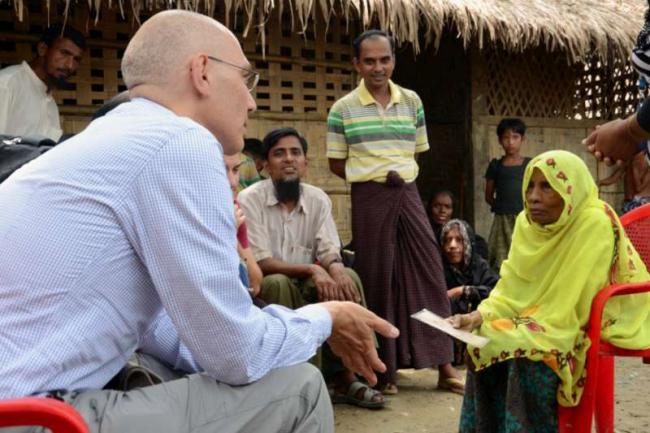
Travelling to a small village an hour's drive from Maungdaw, Türk said he had seen first-hand the impact of restrictions on the Rohingya population and the damage caused by their lack of citizenship.
"Local orders" in place prevent them from moving easily from one village to another, severely limiting their livelihoods.
They are also deprived higher educational opportunities. Since June 2012, Rohingya students have been prohibited from attending Sittwe University – the only university in the state.
Türk spoke directly with the affected populations in Rakhine state, where 140,000 people are still internally displaced after the outbreak of inter-communal violence three years ago.
In a positive development, when breaking the Ramadan fast together with Rakhine and Rohingya community leaders in Maungdaw, he was told that while challenges remain in building trust, the communities have a long history of co-existence.
“We have been living together since before Maungdaw town existed,” said one Rohingya leader.
His comment was then affirmed by a Rakhine representative.
Traveling to Nay Pyi Taw, he held discussions with U Khin Yi, Minister for Immigration and Population, and other government officials and parliamentarians.
Following up on the issues raised in Bangkok in late May during a regional meeting on irregular migration in the Indian Ocean, Türk noted that the recent “boat crisis” in the region and the long-term situation in Rakhine state.
He reiterated UNHCR's readiness to assist all governments in the region, including Myanmar, to address the movements of people from Bangladesh and Myanmar.
At the end of his visit, the Assistant High Commissioner shared his findings at a briefing with diplomats and representatives of international organisations in Yangon.
Describing the regional dimension of the maritime movements in the Bay of Bengal and Andaman Sea, he emphasized that the key to finding solutions is to work with all of the communities and the authorities to promote peaceful co-existence in the Rakhine state.
Photo: UNHCR/K. Rochanakorn
Support Our Journalism
We cannot do without you.. your contribution supports unbiased journalism
IBNS is not driven by any ism- not wokeism, not racism, not skewed secularism, not hyper right-wing or left liberal ideals, nor by any hardline religious beliefs or hyper nationalism. We want to serve you good old objective news, as they are. We do not judge or preach. We let people decide for themselves. We only try to present factual and well-sourced news.
Support objective journalism for a small contribution.


