


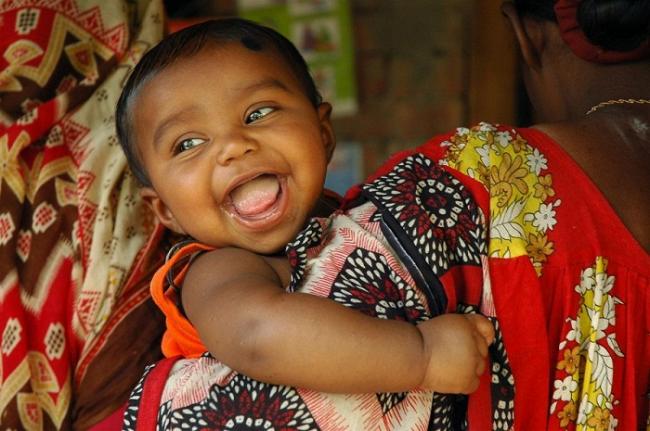
Mothers and children need more social protection: UN labour agency
Isabel Ortiz said, “At a time when the world is discussing a post-2015 development agenda, it is essential that the international community identifies financing sources for social protection."
This, or the social security guarantees to protect them against economic distress and hardship caused by the absence or a substantial reduction of income from work because of illness, maternity, lack of employment, disability, old age and others, Isabel Ortiz, Director of the ILO Social Protection Department said as the agency released two new studies late last week.
In the Social protection for maternity: Key policy trends and statistics report, ILO notes that only 36 per cent of employed women are legally entitled to cash benefits during their maternity leave.
“In practice, however, maternity leave legislation is not implemented effectively, so only 28 per cent of working women are covered in case of maternity,” ILO said in a press release.
“Around 800 women die from childbirth every day. In addition, 18,000 children also pass away daily. The sad reality is that despite efforts carried out as part of the Millennium Development Goals process, maternal and child mortality rates in developing countries are still very high,” according to the UN labour agency.
“Most of these deaths are preventable with adequate social protection. Universal maternal and child health care is key to reducing high mortality rates, together with cash transfers to ensure adequate food, clothing, and access to social services,” added Ortiz.
ILO said a related report, Social protection for children: Key policy trends and statistics, also paints a worrying picture. While there has been an explosion of small cash transfer schemes in recent years, the study shows, there is also a considerable gap with regard to the availability of adequate child and family benefits.
A worrying trend, according to ILO, is that in some countries, the levels of maternity and child protection benefits have dropped as a result of fiscal consolidation policies.
For example, it said, several European countries have reduced the level of maternity and child benefits or have limited the level of coverage, leading to an increase in child poverty in 18 of the 28 countries of the European Union between 2008 and 2013.
The reports include detailed national data on maternity protection and child and family benefits for 188 countries surveyed.
They looked at a sample of 57 low- and lower middle-income countries and show that introducing a basic universal maternity cash benefit would require, on average, 0.41 per cent of national gross domestic product (GDP).
Meanwhile, having universal child benefits would, on average, require 1.9 per cent of national GDP.
The projected costs for a basic universal child benefit vary greatly between countries, ranging from 5.2 per cent of GDP for Niger to 0.2 per cent of GDP for Guyana, considering that children constitute a large proportion of the population in these countries.
The same variation applies to basic universal maternity protection, where it ranges from less than 0.1 per cent of GDP in Bhutan, Guyana, India, Indonesia, Mongolia, Morocco, Sri Lanka and Viet Nam to 1.1 per cent of GDP in Niger.
Photo: UNICEF/Naser Siddique1
Support Our Journalism
We cannot do without you.. your contribution supports unbiased journalism
IBNS is not driven by any ism- not wokeism, not racism, not skewed secularism, not hyper right-wing or left liberal ideals, nor by any hardline religious beliefs or hyper nationalism. We want to serve you good old objective news, as they are. We do not judge or preach. We let people decide for themselves. We only try to present factual and well-sourced news.
Support objective journalism for a small contribution.


