


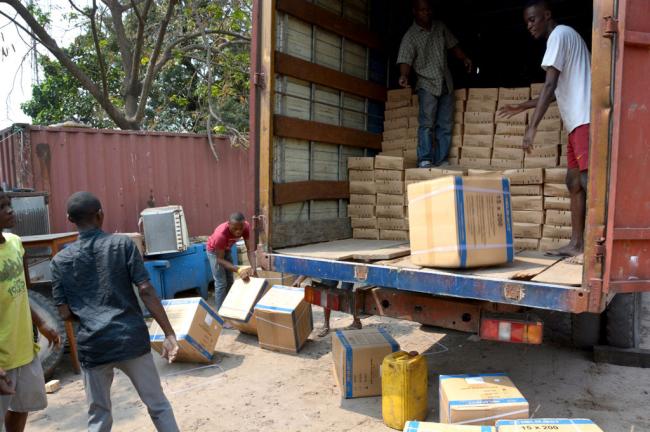
Millions vaccinated against yellow fever in Africa in record time – UN health agency
These vaccinations are a major part of the largest emergency vaccination campaign against yellow fever ever attempted in Africa, the World Health Organization (WHO) highlighted in a news release on Friday.
“WHO commends the Government of the DRC for this significant achievement to roll out such a complex campaign in such a short period of time,” said the WHO Representative in the DRC, Dr. Yokouide Allarangar, in the release.
According to the agency, planning a vaccination campaign of this scale usually takes up to six months, however, this campaign was put in place in a matter of weeks to end transmission of yellow fever before the rainy season starts in September.
Furthermore, a “dose sparing” strategy – using one fifth of the full dose of yellow fever vaccine – was employed for this campaign, under the recommendation of the WHO Strategic Advisory Group of Experts on Immunization, as a short-term emergency measure to reach as many people as possible given limited supplies of the vaccine.
WHO, along with the Ministry of Public Health and more than 50 global partners, worked closely together to roll out the vaccination drive in more than 8,000 locations across the DRC – both in dense, urban areas and in hard-to-reach, remote border regions, the agency said in the release.
The UN health agency played a key role in ensuring the technical feasibility of the strategy, the availability of millions of vaccine doses, syringes and other materials, as well as maintaining the cold chain to ensure vaccines are stored and transported in the right conditions, as well as co-led the coordination efforts in the planning and implementation phases, trained health workers and engaged with communities and leaders in disseminating information about the campaigns.
Other UN entities, including the UN Children’s Fund (UNICEF) and its World Food Programme (WFP) were also an integral part of the campaign. UNICEF led social mobilizers on the ground to engage with communities and encourage people to get vaccinated, as well as helped ensure that vaccines and injection devices were in place. WFP provided temporary safe storage of the huge volumes of waste generated by this campaign that will be sent for incineration in mid-September.
Other key partners include the non-governmental organizations Save the Children and Médecins sans Frontières; the Red Cross of the Democratic Republic of Congo; the US Centers for Disease Control (CDC); Gavi, the Vaccine Alliance; and the World Bank.
Continuing campaigns in DRC and Angola
The WHO news release further noted that over the next few weeks, vaccination teams will focus on completing the campaign in remote border regions of the DRC, and reaching people at risk or those who may have missed out on the first round of vaccination. Also, in Angola, vaccination campaigns are ongoing, with an estimated three million people vaccinated since mid-August.
This latest campaign aims at building on previous emergency yellow fever reactive vaccination campaigns led by national governments that had already reached more than 13 million people in Angola and more than three million in the DRC since the beginning of the outbreak in December 2015.
Since January this year, almost 1,000 people in both countries have had confirmed yellow fever, with many more suspected cases and more than 400 deaths reported.
Though the outbreak in the two countries appears to be declining with no new cases confirmed in over a month, WHO said it is critical to continue providing support to ensure the countries have the capacity to detect and respond to any further cases of yellow fever, particularly because there may still be viral circulation in the mosquito vector, and in other animal reservoirs, as well as in anticipation of the upcoming rainy season that will result in increased risk of transmission.
Photo: WHO/E. Kabambi
Source: www.justearthnews.com
Support Our Journalism
We cannot do without you.. your contribution supports unbiased journalism
IBNS is not driven by any ism- not wokeism, not racism, not skewed secularism, not hyper right-wing or left liberal ideals, nor by any hardline religious beliefs or hyper nationalism. We want to serve you good old objective news, as they are. We do not judge or preach. We let people decide for themselves. We only try to present factual and well-sourced news.
Support objective journalism for a small contribution.


