


Marking World Pneumonia Day, UN calls for greater efforts in preventing child deaths
“Pneumonia is still a very dangerous disease – it kills more children under five than HIV/AIDS, malaria, injuries and measles combined – and though the numbers are declining, with nearly 1 million deaths a year, there is no room for complacency,” said Mickey Chopra, head of UNICEF’s global health programmes, in a press release today.
“Poverty is the biggest risk factor, and that means our efforts need to reach every child, no matter how marginalized,” he added.
Pneumonia is still among the leading killers of children – accounting for 15 per cent of deaths, or approximately 940,000 children per year – but deaths from the disease have declined by 44 per cent since 2000, according to figures released recently by UNICEF.
Deaths from pneumonia are highest in poor rural communities, the agency noted. Household air pollution is a major cause of pneumonia, so children from households that rely on solid fuels such as wood, dung or charcoal for cooking or heating are at high risk.
Overcrowded homes also contribute to higher pneumonia levels. In addition, poor children are less likely to be immunized against measles and whooping cough – which are also among major causes of the disease – so strategies must target low-income communities, UNICEF stressed.
The increased use of pneumonia vaccines, particularly in low-income countries, has led to progress against the disease, but inequities exist even in countries with wide coverage.
“Closing the treatment gap between the poor and the better off is crucial to bringing down preventable deaths from pneumonia,” Mr. Chopra said. “The more we focus on the causes and the known solutions, the faster we will bring this childhood scourge under control.”
Also today, UNICEF’s Supply Division called on innovators to work on improved and more easily affordable respiratory rate timers to aid in the timely recognition and management of pneumonia. Scaling up the availability of inexpensive medicines, such as the antibiotic amoxicillin, will help to reduce the treatment gap, especially among hard-to-reach populations, UNICEF said.
Simple measures such as early and exclusive breastfeeding; hand-washing with soap; vaccination; and provision of micronutrients will also reduce the incidence of pneumonia, UNICEF said.
In a separate news release, the Global Coalition Against Child Pneumonia stressed that as the Millennium Development Goal (MDG) deadline of 2015 approaches, it is necessary to increase progress and boost political commitment towards reducing child mortality. This requires addressing preventable deaths from pneumonia, other infectious diseases, and complications around prematurity at childbirth.
“Combatting pneumonia is essential to achieving the Millennium Development Goals related to health and child survival, and to laying the groundwork for ending all preventable maternal and child deaths by 2030,” said UN Secretary-General Ban Ki-moon in the Coalition’s statement.
“We need a persistent and integrated approach to this preventable and treatable killer of children. I call on all sectors to come together now to defeat this disease,” he added.
The Coalition stressed that although the number of under-five deaths worldwide has decreased by half since 1990, many countries are not on track to reach MDG 4, which calls for a two-thirds reduction in under-five mortality by 2015.
Poor and rural communities in sub-Saharan Africa and South Asia are most behind on achieving this goal, with India, Nigeria, Pakistan, the Democratic Republic of the Congo, and Ethiopia accounting for almost 50 per cent of total pneumonia child deaths.
Together, pneumonia and diarrhoea account for one quarter of all under-five deaths worldwide, and can largely be targeted by the same interventions. Moreover, bringing childhood healthcare closer to the homes of those most affected increases their access to quality prevention and care, which can save the lives of hundreds of thousands of children.
The Coalition noted that the Integrated Global Action Plan for the Prevention and Control of Pneumonia and Diarrhoea of the UN World Health Organization (WHO) and UNICEF proposes a cohesive approach to ending preventable pneumonia and diarrhoea deaths.
“Tackling pneumonia requires an integrated approach to look at ways to prevent and protect children from developing pneumonia in the first place, as well as ways to accurately diagnose and treat the infection when present,” stressed Flavia Bustreo, WHO’s Assistant Director-General for Family, Women’s and Children’s Health.
A key intervention is to prevent exposure to indoor air pollution, she said, noting that those most vulnerable include young children as well as women, who spend the most time near the domestic hearth. Globally, more than 50 per cent of pneumonia deaths among children under 5 are linked to household air pollution.
Seth Berkley, CEO of the GAVI, the Vaccine Alliance said the partnership is working to accelerate the availability of vaccines that protect the world’s children against pneumonia.
“Since 2000, GAVI has helped immunize nearly 200 million children with pentavalent vaccine and more than 25 million with pneumococcal conjugate vaccine, both of which protect against leading causes of pneumonia,” he said. “We are committed to further expanding access to these vaccines as part of an integrated approach to pneumonia prevention and control.”
Several events commemorating World Pneumonia Day are being held today in countries throughout the world. In India, Ethiopia, Nigeria, Pakistan, South Sudan and South Africa, ministries of health and partners in child health, such as UNICEF, WHO, the Joint United Nations Programme on HIV/AIDS (UNAIDS), Jhpiego, the Bill & Melinda Gates Foundation, the International Vaccine Access Center at the Johns Hopkins Bloomberg School of Public Health, and the Malaria Consortium are organizing various activities, including panel discussions, press briefings, roundtables, lectures and a parade, the Coalition said.
The Global Coalition Against Child Pneumonia was established in 2009 to raise awareness about pneumonia and advocate for global action to protect against, treat and help prevent the illness. The Coalition comprises more than 140 non-governmental organizations, civil society organizations, academic institutions, government agencies and foundations.
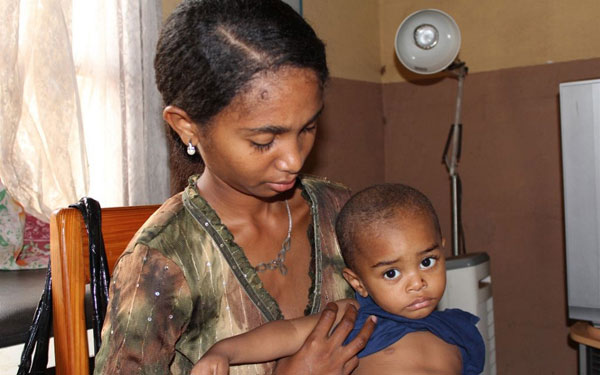
A mother at the Manakara clinic, in south eastern Madagascar, brings her child for pneumonia check-up. Photo: UNFPA
Support Our Journalism
We cannot do without you.. your contribution supports unbiased journalism
IBNS is not driven by any ism- not wokeism, not racism, not skewed secularism, not hyper right-wing or left liberal ideals, nor by any hardline religious beliefs or hyper nationalism. We want to serve you good old objective news, as they are. We do not judge or preach. We let people decide for themselves. We only try to present factual and well-sourced news.
Support objective journalism for a small contribution.


