


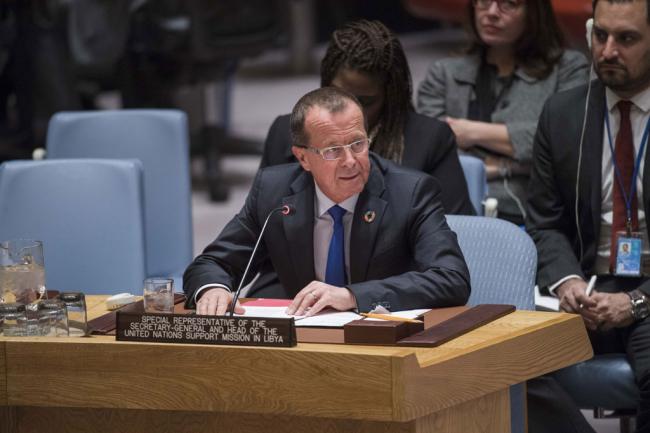
Libyan political accord 'stands firm, but stuck' – UN envoy tells Security Council
UN Special Representative Martin Kobler also underscored that in addition to looking at the security situation in the country, the economic dimensions also needed to be kept on the agenda.
“Until on Tuesday, even the most vociferous critics of the Agreement acknowledge that it is the only workable framework,” Kobler told the Council at its meeting on the north African country.
“That said, the Libyan Political Agreement did not fulfil the expectations. The implementation has stalled,” he added.
Kobler explained factors such as the limited authority of the Government of National Accord (GNA), the rejection, twice, of the proposed lists of GNA by the Libyan House of Representatives, lack of cooperation between State institutions, “pretender” governments competing for power, and crime and volatile security situation continued to add to the worries in the country.
To conclude an agreement is difficult, to implement it is even more difficult, as Nelson Mandela said.
Sounding the alarm, he said the country “continues to be awash” in weapons, and arrivals of new weapons continue unabated, in violation of existing weapons embargo.
“Weapons do not fall from the sky. They come by land or sea,” he stressed, adding that they sometimes end up in the hands of terrorists throughout the region. As such, he called for strong enforcement of the embargo until Libya has a reliable and coherent security set up.
Of special concern, Kobler underscored, were violent clashes in Tripoli – the first since 2014 – triggered by the killing of a religious scholar, and he noted that such clashes were symptoms of the lack of security and underlying tensions between communities.
He added that despite an increase in oil production, the country remains in a budget deficit of about 70 per cent of its gross domestic product (GDP) and said that the strained relations between the Presidency Council and the Central Bank further complicated the financial
“Libya's financial reserves have shrunk from $108 billion in 2013 to $45 billion. The country will face an economic meltdown unless something changes,” he stressed, expressing particular concern for the lack of rule of law, rising corruption and high yields on the black market that result in billions of dollars disappearing into illegitimate accounts.
Next steps
In moving ahead, the UN envoy said that while the implementation of the Agreement is challenged, its articles are “not set in stone.”
“The Libyan Political Agreement foresees a mechanism for change, should the political circumstances demand,” he explained.
He pointed to the need to: tackle outstanding political questions; stop the use of armed groups and instead set up a Presidential Guard (as proposed by the Presidency Council) to protect State institutions and embassies; prioritize economic recovery of Sirte and Benghazi; address the fundamentals of the Libyan economy; promptly act on human rights issues, including the situation of migrants; and the return of the UN Support Mission in Libya (UNSMIL), which he heads up, to Tripoli in a phased manner, once the security concerns are mitigated.
UN Photo/Amanda Voisard
Source: www.justearthnews.com
Support Our Journalism
We cannot do without you.. your contribution supports unbiased journalism
IBNS is not driven by any ism- not wokeism, not racism, not skewed secularism, not hyper right-wing or left liberal ideals, nor by any hardline religious beliefs or hyper nationalism. We want to serve you good old objective news, as they are. We do not judge or preach. We let people decide for themselves. We only try to present factual and well-sourced news.
Support objective journalism for a small contribution.


