


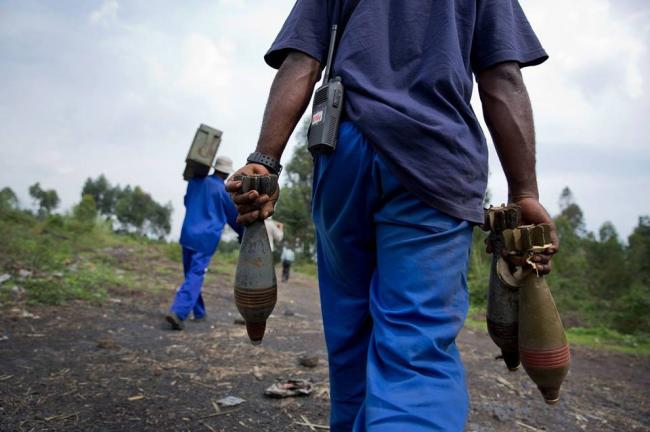
It’s about more than mines: UN official
Agnès Marcaillou, Director of the UN Mine Action Service (UNMAS), told reporters in New York the significance of the commemoration had expanded over the years and that now it was “mine awareness week” rather than just “mine awareness day.”
The theme for this year is ‘More Than Mines’, she said, explaining that an evolution had taken place since the mid-1990s, when the focus had been on anti-personnel landmines and civil society had rallied together to conclude a treaty banning landmines that had since become a cornerstone of international humanitarian law.
She said that since then, the remit of UNMAS had expanded and it was now applying its expertise to an increasingly wide range of explosive hazards that kill and maim people every day.
Work on cluster munitions since the mine ban treaty resulted in a separate treaty banning their use, while unexploded ordnance (UXO) and ammunition were among the main challenges keeping the body busy as they impacted an increasing number of communities. The threat of improvised explosive devices (IEDs) had also caused a reaction by the UN.
They disrupted peacekeeping operations and deliveries of humanitarian assistance and that disruption increased the bill. There were direct costs, along with indirect costs stemming from the slowness of reconstruction and delivery.
She pointed also to a high political cost, seen most clearly when the Security Council’s mandates were not fulfilled because mines and the explosive remnants of war hampered efforts.
She stressed, however, that there is a bright side, which was that the threat posed can be mitigated and the weapons destroyed. To do that more money is required. With more money, more clearance teams could be paid for, which would mean that roads could be more quickly verified and a more coherent response ensured.
Photo: UN Photo/Sylvain Liechti
Support Our Journalism
We cannot do without you.. your contribution supports unbiased journalism
IBNS is not driven by any ism- not wokeism, not racism, not skewed secularism, not hyper right-wing or left liberal ideals, nor by any hardline religious beliefs or hyper nationalism. We want to serve you good old objective news, as they are. We do not judge or preach. We let people decide for themselves. We only try to present factual and well-sourced news.
Support objective journalism for a small contribution.


