


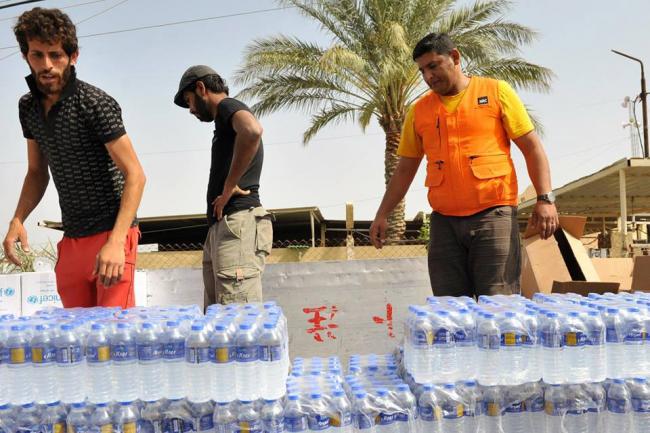
Iraq must protect internally displaced as crisis deepens: UN expert
In a press release from Office of the United Nations High Commissioner for Human Rights (OHCHR), Chaloka Beyani, Special Rapporteur on the human rights of internally displaced persons, called on the international community not to turn its back on the situation in light of a significant shortfall in humanitarian funding.
“Despite some positive steps by the Government, its approach to the displacement crisis has been largely ad hoc to-date,” Beyani said after his first official visit to Iraq from 9 to 15 May.
“Disturbing ongoing developments, including the fall of Ramadi to ISIS [Islamic State of Iraq and Syria], and possible Government offensives to regain lost cities including Mosul, will certainly result in massive new displacement,” he added.
“Despite the challenges in the short, medium and long-term, it is imperative that the international community recognizes its responsibilities and remains a consistent and reliable humanitarian partner,” the UN expert stressed.
He added, “Agencies are stretched thin and unable to address all urgent needs. They can only work with the resources that they have and those are grossly inadequate at the present time.”
“IDPs from all ethnic and religious communities are surviving in precarious conditions, often under the threat of violence and further displacement and with inadequate shelter, healthcare, food and water,” he stated.
He added, “The situation of hundreds of thousands of IDPs living in areas controlled by ISIS [also known as ISIL or the Islamic State in Iraq and the Levant] is unclear and deeply worrying.”
“Access to humanitarian assistance for many IDPs is poor and must improve. This means ensuring access to humanitarian actors,” Beyani said.
He added, “Many IDPs have also lost documents and face bureaucratic barriers to receiving assistance. One family told aid workers ‘we could not save our daughter, how could we save our documents?’”
The expert visited IDPs living in cramped, substandard conditions in collective shelters and unfinished buildings. He noted that a one-off cash payment to families of $700 dollars is insufficient even to cover basic needs including shelter and food.
On another note, at least 100 families had to return from Baghdad to Ramadi where their homes had been damaged when ISIS still controlled much of the city.
Now that the city has reportedly fallen, the Government must allow the newly displaced from Ramadi to freely enter Baghdad.
The Babylon Governorate has refused to admit displaced men between 15 and 50, causing family separation as only women and children are allowed entry.
“While legitimate security concerns exist, including that ISIS may infiltrate IDP communities, the overwhelming majority of IDPs are innocent victims of the conflict and must be treated as such on protection and humanitarian grounds,” the Special Rapporteur concluded.
Chaloka Beyani, professor of international law at the London School of Economics, was appointed Special Rapporteur on the human rights of internally displaced persons by the Human Rights Council in September 2010.
Special Rapporteurs are part of what is known as the Special Procedures of the Human Rights Council, the largest body of independent experts in the UN human rights system. They work on a voluntary basis, are not UN staff and do not receive a salary for their work.
Photo: UNAMI
Support Our Journalism
We cannot do without you.. your contribution supports unbiased journalism
IBNS is not driven by any ism- not wokeism, not racism, not skewed secularism, not hyper right-wing or left liberal ideals, nor by any hardline religious beliefs or hyper nationalism. We want to serve you good old objective news, as they are. We do not judge or preach. We let people decide for themselves. We only try to present factual and well-sourced news.
Support objective journalism for a small contribution.


