


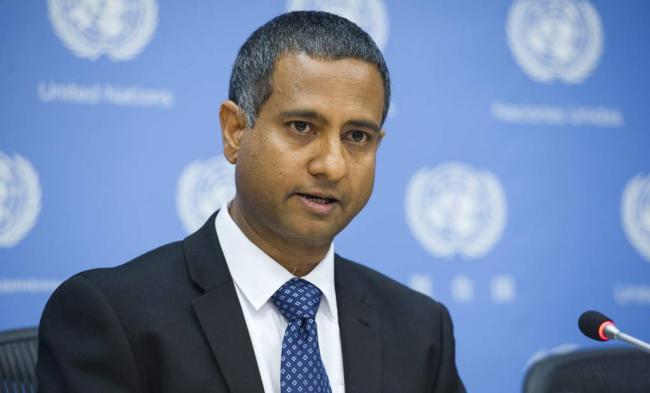
Iran’s execution of juvenile offenders draws concern of UN rights expert
Iran executed at least 966 prisoners in 2015, the highest such rate in 10 years, Ahmed Shaheed, United Nations Special Rapporteur on the situation of human rights in that country, said as he presented his latest report to the UN Human Rights Council in Geneva.
“With at least 16 juvenile offenders reportedly hanged between 2014 [and] 2015, Iran remains one of a few countries still resorting to this practice despite a strict prohibition against it under international law,” Shaheed said, urging Iranian officials to “put aside efforts at piecemeal reform in this area and ensure, once and for all, that no boy or girl who commits a crime under the age of 18 is ever put to death.”
Shaheed also highlighted fundamental flaws in the administration of criminal justice, ranging from laws that expressly violate Iran’s legal obligations to the failure of security, intelligence and judiciary officials to faithfully and properly implement provisions of Iranian law that comply with international law.
While acknowledging positive steps towards real legal reform, he also noted reports that individuals accused of national security and drug crimes are often deprived of the most basic due process and fair trial rights, including proper access to lawyers, long periods of incommunicado detention, torture and ill-treatment and forced confessions used in court to secure convictions.
“Despite recent changes to laws which grant greater procedural safeguards to those suspected of crimes, including the right to access a lawyer at all stages of criminal proceedings, these vital protections are not always implemented in practice,” he said. “There remains a considerable gap between protections afforded to the accused in Iranian law and the reality on the ground.”
Shaheed’s report, which assesses developments since October 2015, also covers other areas of serious concern such as restrictions on the right to freedom of expression, freedom of association and the right to free and fair elections, women’s rights and concerns regarding the rights of religious and ethnic minorities.
While acknowledging the Government’s efforts to engage with his mandate and cooperate with UN human rights bodies, he renewed his call on Iran to increase its engagement with the international community, including those UN human rights mechanisms, by admitting him for a country visit.
Independent experts or special rapporteurs are appointed by the Human Rights Council to examine and report back on a country situation or a specific human rights theme. The positions are honorary and the experts are not UN staff, nor are they paid for their work.
UN Photo/Amanda Voisard
Support Our Journalism
We cannot do without you.. your contribution supports unbiased journalism
IBNS is not driven by any ism- not wokeism, not racism, not skewed secularism, not hyper right-wing or left liberal ideals, nor by any hardline religious beliefs or hyper nationalism. We want to serve you good old objective news, as they are. We do not judge or preach. We let people decide for themselves. We only try to present factual and well-sourced news.
Support objective journalism for a small contribution.


