


International community has obligation to prevent ‘ethnic cleansing’ in South Sudan – UN rights experts
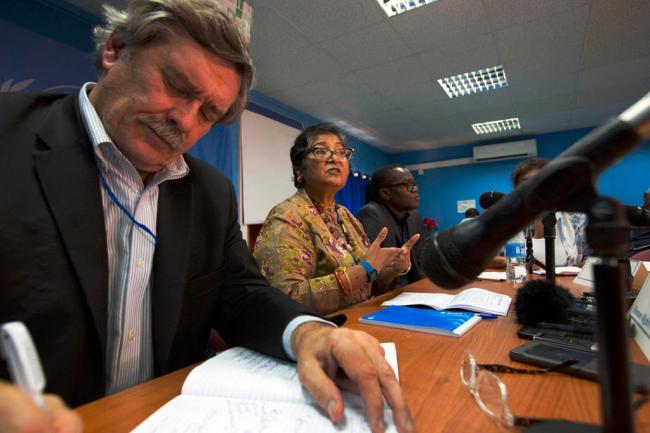
“The stage is being set for a repeat of what happened in Rwanda and the international community is under an obligation to prevent it,” said the Chairperson of the UN Commission on Human Rights in South Sudan, Yasmin Sooka, said in a news release issued by to Office of the UN High Commissioner for Human Rights (OHCHR).
“There is already a steady process of ethnic cleansing underway in several areas of South Sudan using starvation, gang rape and the burning of villages; everywhere we went across this country we heard villagers saying they are ready to shed blood to get their land back,” she reported, adding that many people the experts med during their visit said “it has already reached a point of no return.”
“The scale of rape of women and girls perpetrated by all armed groups in South Sudan is utterly unacceptable and is frankly mindboggling,” she continued, adding that aid workers told the experts that gang rape is so prevalent that it has become ‘normal.’
The Commission met several displaced women in the Juba camp who were gang raped in July and four months later have yet to receive adequate medical treatment for resulting complications.
In a UN protected camp in Bentiu the Commissioners met a woman who described being gang raped by soldiers just three days earlier when her village was attacked, and also heard reports of three women raped that very day by soldiers just outside the camp while going to collect firewood.
In Wau, in Western Bahr el Ghazal state, civilians gave graphic accounts of how their husbands and children were robbed and murdered by soldiers from the army during violence in June in which at least 53 people were killed.
The Equatorias, an area of the country that was relatively unaffected by violence, has now become the epicentre of the conflict, according to Commissioner Godfrey Musila, who visited the area. The picture emerging is one of the presence of armed groups, displacement based on ethnicity, torching of houses, food insecurity and denial of freedom of movement. The Commission heard numerous accounts of corpses being found along main roads, looming starvation and people fleeing to neighbouring countries on a daily basis.
The Commission states that it is widely believed that fighting will intensify during the dry season, which runs until the end of February. To avert mass bloodshed the UN experts lists a number of steps that the international community should take immediately: expedite the immediate arrival of the 4,000-strong Regional Protection Force in South Sudan; ensure that the force is not restricted only to the capital; freeze assets; enact targeted sanctions; and implement an arms embargo.
“It is also urgent to set up the hybrid court promised for South Sudan,” said Commissioner, Ken Scott. “Large parts of the country literally have no functioning courts and even the traditional reconciliation methods are now breaking down with the result that it’s a free for all.”
“As the UN Special Adviser on the Prevention of Genocide said, many of the warning signals of impending genocide are already there – an existing conflict, resort to polarized ethnic identities, dehumanization, a culture of denial, displacement based on ethnicity and in some places indications of systematic violations and planning – but the important thing is there is still time to prevent it,” said Ms Sooka.
Photo: UNMISS
Source: www.justearthnews.com
Support Our Journalism
We cannot do without you.. your contribution supports unbiased journalism
IBNS is not driven by any ism- not wokeism, not racism, not skewed secularism, not hyper right-wing or left liberal ideals, nor by any hardline religious beliefs or hyper nationalism. We want to serve you good old objective news, as they are. We do not judge or preach. We let people decide for themselves. We only try to present factual and well-sourced news.
Support objective journalism for a small contribution.


