


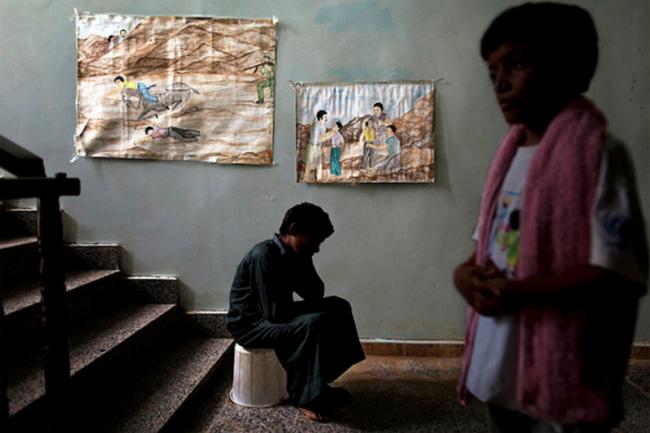
In interview, senior UN official says accountability key to preventing child deaths in conflict
In an interview with UN Radio, scheduled just days before she is due to present the Secretary-General’s latest report on the issue to the Security Council, Ms. Zerrougui described a grim scenario for the world’s conflict-stranded children in 2014 – the period covered by her report – and warned that the situation had not improved.
While mass abductions of children and other civilians have become increasingly prevalent in many of the 23 conflict situations of 2014 that are spotlighted, throughout, the report documents unprecedented challenges regarding the protection of tens of millions of children who are growing up in conflict-affected countries.
Moreover, Children have been killed and maimed, and faced other grave violations, as a result of the targeting of schools by extremist groups that seek to impose their ideology on the wider community.
“If you are a child in an area that is under the control of armed groups, if you’re in Iraq and under the control of [the Islamic State of Iraq and the Levant] (ISIL), or in Syria under the control of ISIL or Al-Nusra; if you’re in a Boko Haram area, then this is a disaster,” explained Zerrougui in her interview.
“Children are killed in their schools, in their homes, in their dormitories. They are abducted – a huge number of children abducted in many places,” she continued. “It’s for us very disturbing and we try to highlight all these trends to the Security Council – the body that can make a difference in the lives of children affected by armed conflict.”
An initial glance at the headlines from 2014 does, in fact, reveal a gloomy narrative regarding the safety of children around the world’s conflict zones. In December, for example, hundreds of children were gunned down in Peshawar, Pakistan, by Taliban militants as they attended school. The conflict in Syria, meanwhile, continued to rage, trapping children in rubble-filled cities and under a deadly rain of barrel bombs. Elsewhere, in Ukraine, a new conflict emerged, resulting in a current count of more than 240 child casualties.
Against this troubling backdrop, Zerrougui warned that “there are so many places where children are suffering” and urged UN Member States to “change and improve” their behaviour and policies in order to best ensure the protection of children during times of conflict.
When children are killed in conflict areas, she added, Member States generally deny intentionality. The deaths of children, like adult civilians, however, indicate “something wrong in the military response.”
“Our recommendation is first to ask Member States to address the plight of children in these conflict areas, and to put in place the tools, the mechanisms, the resources, to protect children,” Zerrougui concluded. “Of course, one major, effective response to end violations against children is accountability, is to fight impunity. When you are a commander on the ground and you know if you go beyond what is allowed, then you will be punished, you will think twice.”
The report includes in its annexes a list of parties, including 51 armed groups, that engage in the recruitment and use of children, sexual violence against children, the killing and maiming of children, attacks on schools and/or hospitals and attacks or threats of attacks against protected personnel, in contravention of international law.
In his observations, UN Secretary-General Ban Ki-moon says “the facts as presented in…the present report speak for themselves and should shock our collective conscience,” and cites several situations, “in particular the Central African Republic, Iraq, Israel/State of Palestine, Nigeria, South Sudan and the Syrian Arab Republic, children were affected to a degree which is an affront to our common humanity.”
As such, Mr. Ban says that he will “put all parties to conflict on notice that those that engage in military action resulting in numerous grave violations against children will, regardless of intent, find themselves under continued scrutiny by the United Nations…”
Member States, the UN chief continues, must re-examine existing policies and practices to stop and prevent grave violations against children. Member States must also be held to account and they, in turn, must hold perpetrators accountable, he adds.
Photo: UNICEF/Brent Stirton
Support Our Journalism
We cannot do without you.. your contribution supports unbiased journalism
IBNS is not driven by any ism- not wokeism, not racism, not skewed secularism, not hyper right-wing or left liberal ideals, nor by any hardline religious beliefs or hyper nationalism. We want to serve you good old objective news, as they are. We do not judge or preach. We let people decide for themselves. We only try to present factual and well-sourced news.
Support objective journalism for a small contribution.


