


 Rising Tensions
'If a war breaks out...': Taliban warns Pakistan after Istanbul peace talks end in deadlock
Kabul/IBNS: The Taliban government in Afghanistan has issued a strong warning to Pakistan, cautioning Islamabad against “testing the patience” of Kabul after the latest round of peace talks in Istanbul failed to produce a breakthrough on the issue of Tehreek-e-Taliban Pakistan (TTP) militants.
The talks, held on November 6–7, aimed to secure a written commitment from the Taliban to curb TTP activities allegedly operating from Afghan soil.
However, the discussions ended without agreement, deepening tensions between the two uneasy neighbours.
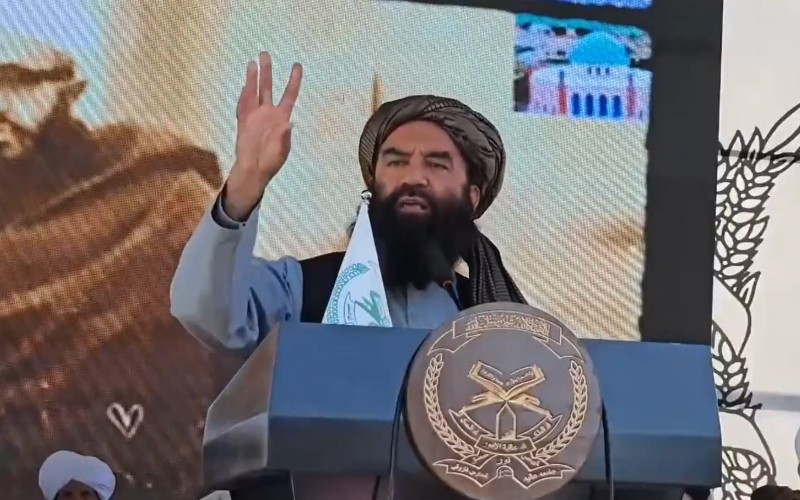
Following the stalemate, Noorullah Noori, Afghanistan’s Minister for Tribes, Borders, and Tribal Affairs, delivered a fiery speech warning Pakistan that Afghanistan’s “elders and youth will rise to fight” if war breaks out.
Afghan minister's dire warning to Pakistan
Speaking at a public gathering, Noori directly addressed Pakistan’s Defence Minister Khawaja Asif, warning him not to rely too heavily on Pakistan’s military technology.
He invoked the failures of the United States and Russia, both of which faced defeat in Afghanistan.
“Pakistan should learn from history,” Noori said, as quoted by TOLO News. “Sindh and Punjab are not far away,” he added, in what was widely viewed as a direct threat should tensions escalate into armed conflict.
His comments came after Asif warned that if the Istanbul talks failed, Islamabad might resort to direct confrontation with the Taliban.
Taliban spokesperson blames Pakistan’s military factions
In a separate statement earlier in the day, Zabihullah Mujahid, spokesperson for the Taliban’s Islamic Emirate, accused certain factions within Pakistan’s military of deliberately destabilising bilateral relations.
“These elements are unhappy with a strong and stable Afghanistan,” Mujahid said. “They benefited from Afghanistan’s insecurity, migration, and crises for decades, and now they are seeking new excuses for confrontation.”
He blamed the emergence of the Tehreek-e-Taliban Pakistan (TTP) in 2002 on “misguided policies” by segments of Pakistan’s military establishment, which, according to Mujahid, had cooperated with the United States during its war on terror while allowing drone strikes in Waziristan that turned local populations hostile.
Taliban accuses Pakistan of sabotaging peace efforts
Mujahid further claimed that the Taliban government had supported efforts to facilitate direct talks between Islamabad and the TTP, leading to a long-term ceasefire and partial progress in negotiations.
However, he said that these gains were “sabotaged by certain factions” within Pakistan’s military.
“The Islamic Emirate remains committed to ensuring that no one uses Afghan territory to interfere in another country’s affairs,” Mujahid stated. “We will continue to take necessary measures to prevent such actions.”
Afghanistan calls Pakistan ‘irresponsible’ during Istanbul talks
In a statement following the collapse of the Istanbul negotiations, Afghanistan accused Pakistan of taking an “irresponsible and non-cooperative” approach.
Afghan officials alleged that Islamabad tried to shift all security responsibility onto Kabul, while refusing to address its own internal issues related to militant groups.
The Istanbul round marked the third consecutive failure in peace talks mediated by Turkey and Qatar since October, when deadly border clashes erupted between Afghan and Pakistani forces from October 11 to 15.
The first round of talks began in Doha on October 29, followed by a second round in Istanbul on October 25, both of which ended without progress.
The latest November 6–7 meeting collapsed similarly, with no schedule announced for a fourth round.
Rising regional tensions
The failure of the talks underscores the growing mistrust between Islamabad and Kabul, whose relations have steadily deteriorated since the Taliban’s return to power in 2021.
Pakistan continues to accuse the Taliban of harbouring TTP militants, who have carried out a series of cross-border attacks targeting Pakistani security forces, while Afghanistan accuses Pakistan of meddling in its domestic affairs and of harbouring resentment toward a “unified and stable Afghan government.”
As both sides exchange heated rhetoric, regional observers warn that the Istanbul impasse could escalate into a larger security crisis, with cross-border skirmishes threatening to destabilise the already volatile Durand Line region.
Support Our Journalism
We cannot do without you.. your contribution supports unbiased journalism
IBNS is not driven by any ism- not wokeism, not racism, not skewed secularism, not hyper right-wing or left liberal ideals, nor by any hardline religious beliefs or hyper nationalism. We want to serve you good old objective news, as they are. We do not judge or preach. We let people decide for themselves. We only try to present factual and well-sourced news.
Support objective journalism for a small contribution.


