


'Highly fragile' humanitarian situation in Mali demands urgent assistance-UN officials
“The situation in Mali remains highly fragile,” said John Ging, Operations Director for the UN Office for the Coordination of Humanitarian Affairs (OCHA) in a press release issued after a briefing for reporters at UN Headquarters in New York.
“Although humanitarian assistance cannot provide the solution to this crisis, which goes back more than 50 years, it can provide a critical contribution by ensuring that human suffering is alleviated and people’s resilience is rebuilt, while the political process continues,” he added.
Ging, who made the trip along with UN Children’s Fund (UNICEF) Emergency Director, Afshan Khan, and UN Population Fund (UNFPA) Emergency Director, Mabingue Ngom, travelled to the regions of Gao and Kidal where they met with representatives of armed groups, government officials, humanitarian partners and women’s groups. In Bamako, the country’s capital, they also met with the Prime Minister and Minister of Solidarity.
Despite initial security improvements in 2013, the situation in Northern Mali has deteriorated since the beginning of this year. An increase in incidents involving improvised explosive devices, mostly targeting Malian and international security forces, has impeded the return to normalcy and resumption of economic and development activities.
The first phase of the inter-Malian negotiation process, which was held from 16 to 24 July in Algiers, aimed at achieving a comprehensive peace agreement which would end the crisis. It concluded with the adoption of a roadmap by all parties.
Announcement of the resumption of the talks comes in the wake of a series of deadly attacks against the UN Mission in the country, including a bomb attack and an ambush that killed nine Nigerien MINUSMA peacekeepers in Mali's Gao region, bringing the total number of fatalities suffered by the mission to 31 peacekeepers killed and 91 wounded since it first deployed on 1 July 2013.
In the press release, Ging pointed out that the 2014 humanitarian appeal for Mali was less than 50 per cent funded, directly impacting the UN’s presence on the ground and its ability to provide aid to those in need.
“The UN Humanitarian Air Service (UNHAS) has had to halve its fleet, reducing access to remote locations at a critical moment in the response; roaming surgical teams have had to halt their activities; and we can’t deliver basic school supplies, like backpacks and books,” he continued.
Meanwhile, UNICEF’s Afshan Khan underscored the need for restoring basic services across the country, noting that an estimated 500,000 children across Mali will suffer from Global Acute Malnutrition by the end of the year.
“Despite the challenges, we must strengthen health systems especially in response to the nutrition crisis in Mali,” he said, adding that it was “also imperative to get schools back up and running.”
“Some children in northern Mali have gone three years without education. This is unacceptable.”
For his part, UNFPA Emergency Director, Mabingue Ngom, stated that the impact of the Malian crisis on women and importance of women’s involvement in the recovery remained a constant theme during the course of the visit.
“Women in Gao had a simple message for us,” Ngom said. “They asked to have legal remedies for the horrendous violence and suffering they have endured, to be given the skills and means to earn their own livelihoods, and to be actively involved in peace talks and national reconciliation.”
At the same time, as Mali addresses the confirmation of its first death from Ebola, the three officials urged all actors to take “immediate action” drawing on best practices from the region, including Nigeria, to rapidly contain the virus.
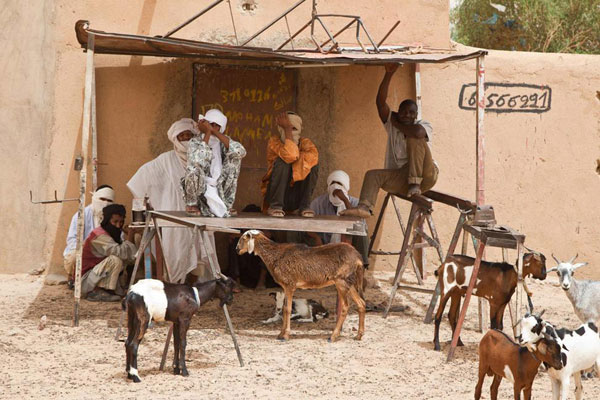
Bystanders on the street of Kidal, Mali. UN Photo/Mark Garten
Support Our Journalism
We cannot do without you.. your contribution supports unbiased journalism
IBNS is not driven by any ism- not wokeism, not racism, not skewed secularism, not hyper right-wing or left liberal ideals, nor by any hardline religious beliefs or hyper nationalism. We want to serve you good old objective news, as they are. We do not judge or preach. We let people decide for themselves. We only try to present factual and well-sourced news.
Support objective journalism for a small contribution.


