


Haiti: UN agricultural development fund supports hurricane-affected farmers with $11 million
New York, Aug 3 (IBNS): With many rural areas in Haiti still recovering from the devastation caused by Hurricane Matthew in 2016, the International Fund for Agricultural Development (IFAD) announced on Thursday that it is investing $10.8 million help restore agricultural productivity in some the worst affected areas of the island nation.
The funds will be distributed through the Agricultural and Agroforestry Technological Innovation Programme, known by its French acronym PITAG, extending its reach to eight additional municipalities in Haiti’s South Department, and spreading sustainable agricultural practices and technologies.
"Haiti's rural population suffers from a vicious circle of low agricultural productivity, high environmental degradation and poor nutrition,” said Lars Anwandter, who leads IFAD's programme in Haiti.
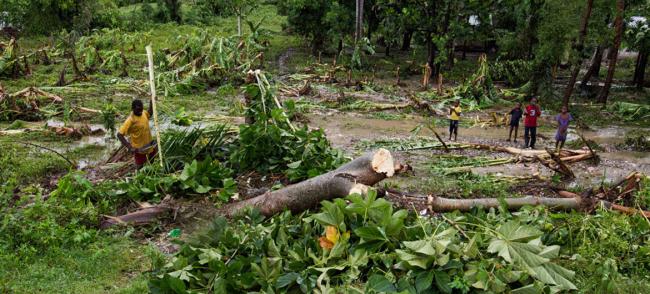
Weak agricultural practices in Haiti have been compounded by a series of natural disasters. The most recent, Hurricane Matthew, which struck the south-western part of the tiny island nation on 4 October 2016, left 2.1 million people severely affected, according to the UN Office for the Coordination of Humanitarian Affairs (OCHA).
As of February 2018, some 622,100 are reportedly still in need of food security assistance.
While the situation in Haiti has improved since the hurricane hit, deep-seated vulnerabilities persist. Over the past few decades, Haiti has seen its soils, water reservoirs and woods severely degraded. World Bank data shows that 59 per cent of the total population lives below the poverty line and the figure rises to 75 per cent in rural areas.
Today, Haiti produces only 45 per cent of the food that Haitians need.
“[PITAG] aims to break this cycle and help small farm families improve their productivity, food security and income levels," said Mr. Anwandter. For example, the programme proposes the combinations of fruit trees and vegetable cultivations as a means to achieve larger harvests and feed more people, all in an environmentally-sustainable manner.
The new technologies and practices endorsed by PITAG will be put in place through farmer field schools, a method of learning which involves community-based and peer-to-peer teaching programmes. After the training, small farmers will get tools, seeds and other inputs to practice the innovations they will have learned.
Currently, PITAG – a $76.8 million programme – is already under way in many areas of Haiti thanks to financial support from the Inter-American Development Bank (IDB) and the Global Agriculture and Food Security Program (GAFSP).
With 65,000 small farming households targeted, the project focuses particularly on women, youth and other vulnerable groups.
UN/MINUSTAH/Logan Abassi
Support Our Journalism
We cannot do without you.. your contribution supports unbiased journalism
IBNS is not driven by any ism- not wokeism, not racism, not skewed secularism, not hyper right-wing or left liberal ideals, nor by any hardline religious beliefs or hyper nationalism. We want to serve you good old objective news, as they are. We do not judge or preach. We let people decide for themselves. We only try to present factual and well-sourced news.
Support objective journalism for a small contribution.


