


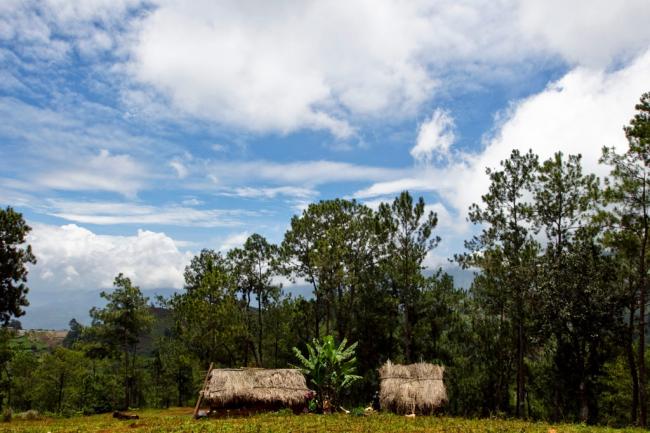
Greener energy for a third of the world bodes well for all, says UN on International Forest Day
“This is an area where we can make a real difference,” saidWu Hongbo, UN Under-Secretary-General for Economic and Social Affairs.
“Sustainably managed forests are productive and resilient ecosystems, providing people with livelihoods and renewable energy, along with timber, food, shelter, clean air, water and climate benefits,” he added.
At the same time, fuel wood – the primary source of energy for nearly a third of the world’s population and a product derived from forests – is also an important part of the energy equation.
However, current fuel production practices (such as production of charcoal) are not only contributing to degradation of forests and soils, they are estimated to cause up to seven per cent of global greenhouse gas emissions caused by humans.
Most of the emissions is largely due to unsustainable forest management and inefficient charcoal manufacture and fuelwood combustion, FAO said in the report, The Charcoal Transition, which was launched coinciding with the International Day of Forests .
“This is especially important for poor people in rural areas of developing countries, where wood is often the only energy source available [and its] conversion to charcoal is often done using rudimentary and polluting methods,” noted FAO Director-General José Graziano da Silva announcing the report at a ceremony marking the International Day in Rome.
Forests, energy, climate change and sustainable development
Forests and energy are also linked to sustainable development and can help combatting climate change.
According to estimates, about a third of the world’s population (about 2.4 billion people) still rely on the traditional use of woodfuel for cooking, and many small enterprises use fuelwood and charcoal as the main energy carriers for various purposes such as baking, tea processing and brickmaking.
Of all the wood used as fuel worldwide, about 17 per cent is converted to charcoal, however the production often relies on inefficient technologies and unsustainable resources and in some cases the emission of greenhouse gas can be as high as nine kilograms of carbon dioxide-equivalent per kilogram of charcoal produced.
“Ensuring access to affordable, reliable, sustainable and modern energy is one of the 17 Sustainable Development Goals (SDGs) [and it is] fundamental for addressing the impacts of climate change and eliminating extreme poverty and hunger,” explained the head of FAO.
“We need, for instance, to adopt improved technologies for energy conversion,” he noted, referring to the UN agency’s programmes to deliver fuel-efficient stoves, especially for poor people in Latin America and Africa.
Greening the charcoal value chain and applying sustainable forest management practices can, therefore, mitigate climate change and further efficiencies can be gained by reducing charcoal waste, for example, by transforming charcoal dust into briquettes, adding a new iteration to the energy cycle.
Economic benefits and environmental improvements
The FAO report also argues that although the transition from unsustainable to sustainable sourcing could impose costs on the charcoal value chain, a greener charcoal sector would have an overall positive economic impact.
For instance, a cost-benefit analysis in Kenya estimated that a transition to efficient charcoal production would require an investment of $15.6 million per year excluding upfront costs. However, it would generate $20.7 million in benefits.
At the same time, demand for sustainable charcoal production can provide opportunities for afforestation and reforestation. And providing local people with greater tenure security can increase their willingness and ability to invest in sustainable approaches.
Furthermore, fostering an enabling political environment and an attractive investment climate for transition to a greener charcoal sector can also help increase government revenue collection and investments in sustainable forest management and efficient wood conversion technologies.
A win-win for all concerned, including for the forests.
UN Photo/Logan Abassi
Source: www.justearthnews.com
Support Our Journalism
We cannot do without you.. your contribution supports unbiased journalism
IBNS is not driven by any ism- not wokeism, not racism, not skewed secularism, not hyper right-wing or left liberal ideals, nor by any hardline religious beliefs or hyper nationalism. We want to serve you good old objective news, as they are. We do not judge or preach. We let people decide for themselves. We only try to present factual and well-sourced news.
Support objective journalism for a small contribution.


