


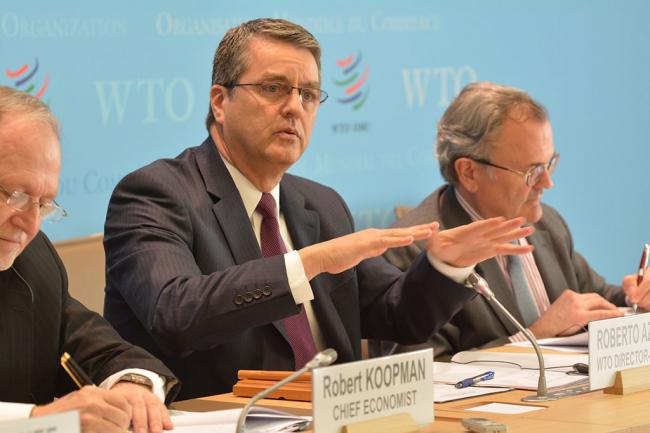
Global trade to expand by 2.4 per cent in 2017 amid ‘deep’ geopolitical, economic uncertainty – WTO
The WTO, which often cooperates with the United Nations on trade matters, forecast that global trade will expand by 2.4 per cent in 2017, but only if the global economy recovers as expected and governments pursue the right policy mix. Owing to this uncertainty, this figure is placed within a range of 1.8 per cent to 3.6 per cent. In 2018, the WTO is forecasting trade growth between 2.1 per cent and four per cent.
The unpredictable direction of the global economy in the near term and the lack of clarity about government action on monetary, fiscal and trade policies raises the risk that trade activity will be stifled. A spike in inflation leading to higher interest rates, tighter fiscal policies and the imposition of measures to curtail trade could all undermine higher trade growth over the next two years, said the WTO.
"Weak international trade growth in the last few years largely reflects continuing weakness in the global economy,” said WTO Director-General Roberto Azevêdo on the launch of the organization’s 2017-2018 forecasts, adding that trade has the potential to strengthen global growth if the movement of goods and supply of services across borders remains largely unfettered.
However, if policymakers attempt to address job losses at home with severe restrictions on imports, trade cannot help boost growth and may even constitute a drag on the recovery, he continued.
‘We need to keep using trade to deliver more benefits to more people’ – WTO chief
Picking up that thread in a press conference earlier on Wednesday in Geneva, he said that overall, while there are some reasons for cautious optimism, trade growth remains fragile and there are considerable risks to the downside. Much of the uncertainty around the outlook is of course political — and not only geopolitical. Part of this is driven by people's concerns about the impact that trade can have.
The fact is that trade plays a very beneficial role in the economy overall. It is net positive. It drives growth, job creation and development, he said, but stressed: “Nevertheless, people's concerns cannot be ignored. A net gain for the economy as a whole — or for other individuals — means little to someone who has lost their job. But in finding the right response we have to look at the whole picture.”
Azevêdo said that the fact is that the economy is changing fast – driven by technology and innovation. Eight in 10 manufacturing jobs are lost to innovative technologies and higher productivity. It is estimated that 65 per cent of children entering primary school on Wednesday will end up working in types of jobs that don’t yet exist.
“We have to adapt to this new reality. That means applying the right mix of policies across a range of areas. At the domestic level, policies are needed to help support the workers of on Wednesday and train the workers of tomorrow,” he said, underscoring: Closing the borders to trade would only worsen the situation – it would not bring the jobs back, it would make more jobs disappear.”
He called for measures to keep using trade to deliver more benefits to more people. More trade integration can help make the system more inclusive – connecting new industries and smaller players to new markets.
Photo: WTO
Source: www.justearthnews.com
Support Our Journalism
We cannot do without you.. your contribution supports unbiased journalism
IBNS is not driven by any ism- not wokeism, not racism, not skewed secularism, not hyper right-wing or left liberal ideals, nor by any hardline religious beliefs or hyper nationalism. We want to serve you good old objective news, as they are. We do not judge or preach. We let people decide for themselves. We only try to present factual and well-sourced news.
Support objective journalism for a small contribution.


