


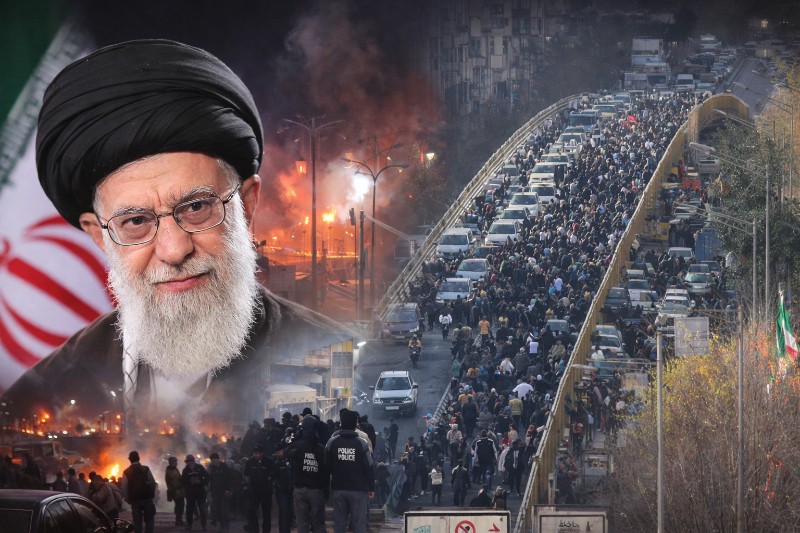
 Iran Unrest
From currency crash to street bloodshed: What sparked Iran’s deadliest protests in three years
Tehran/IBNS: Iran is witnessing its deadliest wave of protests in three years as demonstrations triggered by economic collapse spiral into violent clashes with security forces, leaving multiple people dead across several provinces.
What began as anger over a plunging currency and soaring prices has evolved into a broader expression of frustration with Iran’s clerical leadership, marking one of the most serious domestic challenges the country has faced since the 2022 Mahsa Amini uprising.
Authorities have confirmed fatalities among both protesters and security personnel, while rights groups report an even higher death toll.
BREAKING: Islamic Republic forces are retreating, as more Iranians flood the streets of Iran. pic.twitter.com/onZVnSNEbj
— Eyal Yakoby (@EYakoby) January 1, 2026
The unrest has spread beyond Tehran into western and southern provinces, underscoring the depth of economic distress gripping the country.
What triggered the protests?
The protests began on Sunday after Iran’s currency, the rial, suffered another sharp fall against the US dollar, intensifying a cost-of-living crisis that has pushed inflation above 40 percent.
In 2025 alone, the rial has lost roughly half its value, eroding savings and crippling purchasing power.
Shopkeepers and traders were the first to take to the streets, shutting down major bazaars in protest of rising prices and government mismanagement.
Killing is the regime’s response to protest.
— Masih Alinejad 🏳️ (@AlinejadMasih) January 1, 2026
On Monday, President @realDonaldTrump said the Iranian regime kills its own people.
Today, the world is witnessing exactly that.
On the fifth day of unrest in Iran, crowds filled the streets of Lordegan as gunfire rang out.
Videos… pic.twitter.com/0Uiun5AWkY
Within days, university students and ordinary citizens joined demonstrations, chanting slogans that increasingly moved beyond economic grievances to target Iran’s theocratic system itself.
Years of US and Western sanctions over Iran’s nuclear programme, combined with regional tensions and recent military confrontations, have worsened the economic squeeze, creating what many analysts describe as a breaking point for public patience.
Violence spreads beyond Tehran
While protests initially erupted in the capital, they soon spread to provinces including Lorestan, Fars, Hamedan, Isfahan, Khuzestan and Kermanshah.
The most deadly incidents were reported in western cities largely inhabited by Iran’s Lur ethnic group.
In the city of Kouhdasht, authorities confirmed the death of Amirhossam Khodayari Fard, a 21-year-old member of the Basij paramilitary force affiliated with the Islamic Revolutionary Guards Corps.
Protests continued well into the night inside Iran, as seen here in 1. Isfahan 2. smashing down gates of a governmental building in Fars province and 3. the seizure and burning of a Basij headquarters in Asadabad, Hamadan last night. Most significantly however in 4. Baghmalek,… pic.twitter.com/OVCRfLXwbx
— Omid Djalili (@omid9) January 1, 2026
State media said he was killed during clashes with demonstrators, while rights group Hengaw claimed he was protesting and was shot by security forces.
In Lordegan, videos verified by international media showed protesters gathering as gunfire rang out.
Do not ever again call Iranian spineless people who are too afraid to rise up, until you yourself have faced the world's largest terrorist mafia with only your naked fists.
— 𝐍𝐢𝐨𝐡 𝐁𝐞𝐫𝐠 ♛ ✡︎ (@NiohBerg) January 1, 2026
These brave citizens are risking their lives for freedom.
Stand with Iran.
pic.twitter.com/e3j5XVJ8Qf
Semi-official Iranian outlets reported two deaths there, while rights groups alleged that security forces opened fire on demonstrators, killing and wounding several people.
Another protester was reportedly shot dead in Isfahan province.
Security forces and protesters both suffer losses
Iranian authorities say multiple police officers and Basij members have been injured by stone-throwing and confrontations.
At the same time, rights organisations accuse security forces of using live ammunition and excessive force to suppress unrest.
#Breaking: The statue of Ebrahim Raisi, the dead terrorist president of #Iran’s Islamic Regime, has fallen from its pedestal just days after being installed in Ardabil, northwest Iran.#IranProtests pic.twitter.com/xArMQTTd9L
— Babak Taghvaee - The Crisis Watch (@BabakTaghvaee1) January 1, 2026
Footage circulating on social media shows security personnel firing at crowds and deploying tear gas as protesters attempted to breach government buildings.
Iranian state media has blamed “rioters” and “armed elements” for the violence, while activists insist the protests are overwhelmingly driven by economic desperation.
A critical moment for Iran’s leadership
The unrest comes at a particularly fragile moment for Iran’s rulers.
The country is still reeling from a 12-day air war with Israel in June, during which the United States bombed Iranian nuclear facilities.
Holy shit.
— Kosher🎗 (@koshercockney) December 31, 2025
Iran.
The people are not going to give up. pic.twitter.com/qrQC90pTPC
Those events further strained government finances and heightened public anger.
President Masoud Pezeshkian, a reformist who took office promising engagement and economic relief, has acknowledged the limits of his options as the rial continues to slide, with one US dollar now costing around 1.4 million rials on the open market.
BIG: In Iran’s Lordegan, massive clashes reported as armed protesters shoot at the regime forces. Protesters also set the Governor’s office on fire as they have done in other cities, and there are reports of them taking over the judiciary & IRGC buildings. pic.twitter.com/EgVo5g26Io
— Aditya Raj Kaul (@AdityaRajKaul) January 1, 2026
While Pezeshkian has said his government will listen to the “legitimate demands” of protesters, Iran’s prosecutor general has warned that any attempt to destabilise the country will face a “decisive response”.
Government response: Dialogue and crackdown
Tehran has paired security measures with gestures of outreach.
Government spokesperson Fatemeh Mohajerani announced plans for direct dialogue with trade unions and merchants, though details remain vague.
At the same time, authorities declared a nationwide public holiday, officially citing cold weather.
REGIME IN CHAOS: New video shows protesters reportedly ripping down the gate of a government building in southern Iran.
— Fox News (@FoxNews) January 1, 2026
Iran ground to a near standstill this week as businesses, universities and government offices closed under a government-ordered shutdown amid protests caused… pic.twitter.com/TfBie5Bwtv
Critics widely viewed the move as an attempt to empty streets and contain demonstrations.
Schools, universities and public institutions were closed, and security presence was heightened in protest hotspots.
Arrests have been reported across multiple provinces, with state media claiming to have detained individuals allegedly linked to opposition or foreign-based groups.
Echoes of 2022, but a different spark
The current protests are the largest since the nationwide uprising sparked by Mahsa Amini’s death in police custody in 2022.
While not yet as widespread or intense, this wave is notable for its strong economic roots, rather than a single triggering incident tied to social freedoms.
Iranians fight back against Jihad:
— Goldie Ghamari | گلسا قمری (@gghamari) January 1, 2026
I'm not usually a fan of violence.
But in Iran I fully support the right of the unarmed Iranian people (who are being murdered by the terrorist Islamic Dictatorship) to fight back against their savage Islamic oppressors.pic.twitter.com/MISrYZ5HxW
Chants against Iran’s theocratic system suggest that economic despair is once again morphing into political dissent, raising concerns among authorities about a broader challenge to state control.
As inflation bites deeper and the currency continues to fall, Iran’s deadly protests reflect not just a reaction to immediate hardship, but a warning signal of mounting public anger in a nation under sustained economic and political pressure.
Support Our Journalism
We cannot do without you.. your contribution supports unbiased journalism
IBNS is not driven by any ism- not wokeism, not racism, not skewed secularism, not hyper right-wing or left liberal ideals, nor by any hardline religious beliefs or hyper nationalism. We want to serve you good old objective news, as they are. We do not judge or preach. We let people decide for themselves. We only try to present factual and well-sourced news.
Support objective journalism for a small contribution.


