


FEATURE: UN Police heavyweights steer strategies for safer world
Since the 1960s, the UN has been deploying police officers for service in peace operations with a mandate limited to monitoring, observing and reporting. Beginning in the early 1990s, their role increased substantially when they were tasked to work with domestic police and other law enforcement.
In this dedicated annual Police Week, lead officers from 86 countries have been keeping the Organization abreast of their contribution to effective policing in 12 peacekeeping and six Special Political Missions around the world.
Their “to do” list is actually even more extensive than that. In addition to helping restore confidence in host-State police, they provide electoral and border security and management, to rein in transnational organised crime. They also investigate and prevent cases of sexual and gender-based violence.
To explain police activities and implementation of their mandate, this week UNPOL Heads in the UN Multidimensional Integrated Stabilization Mission in Mali (MINUSMA), UN Organization Stabilization Mission in the Democratic Republic of the Congo (MONUSCO)and the UN Mission in Liberia (UNMIL), among others, briefed the Special Committee on Peacekeeping Operations.
Meanwhile, others briefed the Security Council. The protection of civilians in South Sudan, gender sensitive policing in Sudan’s Darfur, safety and security in Mali and capacity-building in Haiti were key topics.
UN Stabilization Mission in Haiti
Brigadier General Georges-Pierre Monchotte of France is the Police Commissioner of the UN Stabilization Mission in Haiti (MINUSTAH). He talks about how UNPOL assisted the Haitian National Police (HNP) in providing security during the humanitarian crisis caused by Hurricane Matthew.
To better respond to challenges and substantively engage on key issues, Heads of Police components also held thematic discussions on early warning mechanisms, preventing and addressing threats, the protection of civilians and police military cooperation, capacity-building, and development and performance.
UN-AU Mission in Darfur
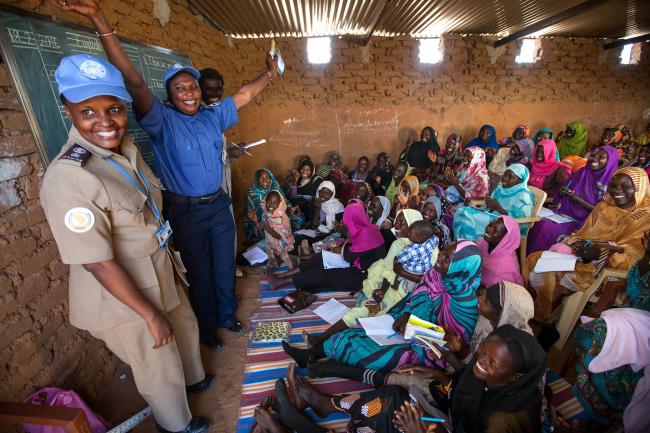
Police Commissioner Priscilla Makotose, the most senior female in UNPOL, oversees more than 3,000 police in Sudan – the largest police component. She explains that the priorities of the UN-AU Mission in Darfur (UNAMID) police are to protect civilians and create a protective environment for communities in Darfur.
As policing has become a more central element in peace operations, 2016 has been a particularly exciting year for UNPOL – acting as a bridge between peace interventions and post-conflict stability, developing effective, accountable and transparent rule of law institutions.
UN Mission in Liberia
Australian national, Police Commissioner Greg Hinds of the UN Mission in Liberia (UNMIL) explains how UNPOL is helping the Liberian Government to develop its national security strategy.
Three things are serving as a basis for discussions: the far-reaching recommendations of the independent Police Division External Review, the outcome of the historic June 2016 UN Chiefs of Police Summit and the report of the Secretary-General to the Security Council on UN policing.
UN Mission in South Sudan
Police Commissioner Bruce Munyambo of Rwanda expounds on the four main goals of the UN Mission in South Sudan (UNMISS): to help the Government protect civilians; monitor human rights; create conducive conditions for delivering humanitarian assistance; and support the implementation of the cessation of hostilities agreement.
UN Mission in Somalia
UNPOL plays an important role in the UN Mission in Somalia (UNSOM). Police Commissioner Christoph Buik elaborates on the agreements in place for a police model after June negotiations with the Government.
UN Police Division
The UN Police Division totals about 100 officers. Three units in New York support planning and policy development; assist missions with officer recruitments; responds to sexual and gender-based violence; and takes the global lead in partnerships and regional cooperation.
In Brindisi, Italy, the Standing Police Capacity consists of 40 officers who assist in providing rapidly deployable, effective, and coherent policing expertise to UN peacekeeping operations, post-conflict and other crisis situations.
Overall, the Police Division embodies the two fundamental ingredients for lasting peace and stability in post-conflict societies, namely security and justice.
UN Photo/Albert González Farran
Source: www.justearthnews.com
Support Our Journalism
We cannot do without you.. your contribution supports unbiased journalism
IBNS is not driven by any ism- not wokeism, not racism, not skewed secularism, not hyper right-wing or left liberal ideals, nor by any hardline religious beliefs or hyper nationalism. We want to serve you good old objective news, as they are. We do not judge or preach. We let people decide for themselves. We only try to present factual and well-sourced news.
Support objective journalism for a small contribution.


