


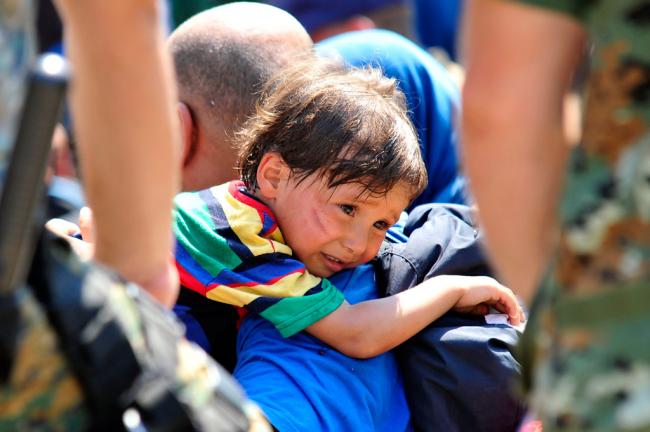
Europe's restrictive measures draw UN concern as refugee and migrant influx continues
Speaking at a press briefing in Geneva earlier today, Melissa Fleming, a spokesperson for the Office of the UN High Commissioner for Refugees (UNHCR), underscored that despite rougher seas, harsh winter weather and numerous hardships endured upon arrival, more than 80,000 refugees and migrants arrived in Europe by boat during the first six weeks of 2016, with more than 400 dying in their attempt. Comparably, large numbers began arriving in Europe only by July 2015.
In the month of January alone, nearly 58 per cent of refugees and migrants arriving in Europe were women and children, and one in three people arriving to Greece were children, as compared with one in 10 in September 2015. More than 91 per cent of those arriving in Greece came from the world's top 10 refugee-producing countries, including Syria, Afghanistan and Iraq, UNHCR said.
In response to the situation, Fleming expressed hope that European Union Member States will implement at a faster pace all EU-wide measures agreed upon in 2015, including the implementation of hotspots and the relocation process for 160,000 people already in Greece and Italy.
She also expressed regret that despite repeated calls by UNHCR to expand legal pathways to allow refugees to access asylum, many European Member States are in fact reducing the available legal avenues, suggesting that some countries are prioritizing keeping refugees and migrants out over finding realistic solutions.
Fleming noted that in Denmark, restrictive measures on family reunification were imposed in January, with refugees now only able to apply for their family to join them after three years, instead of one. Other countries are contemplating similar or even more restrictive legislation, she said, stressing that the issue cannot simply be shifted from one country to another.
Recognizing that some European countries are facing challenges due to significant arrivals of asylum-seekers, refugees and migrants, as well as the fact that States have a sovereign right to manage their borders, the spokesperson reiterated that such actions must be done in accordance with national, European Union and international law, she concluded.
Quick and thorough support mechanisms will be crucial for integrating people in countries receiving the highest number of refugees, including Germany and Sweden, to help dispel the fear and xenophobia and reinstate the common European principles of dignity, solidarity and human rights that the European Union was founded upon.
Photo: UNICEF/Tomislav Georgiev
Support Our Journalism
We cannot do without you.. your contribution supports unbiased journalism
IBNS is not driven by any ism- not wokeism, not racism, not skewed secularism, not hyper right-wing or left liberal ideals, nor by any hardline religious beliefs or hyper nationalism. We want to serve you good old objective news, as they are. We do not judge or preach. We let people decide for themselves. We only try to present factual and well-sourced news.
Support objective journalism for a small contribution.


