


Enhancing regional partnerships among top priorities for UN Peacebuilding Commission in 201
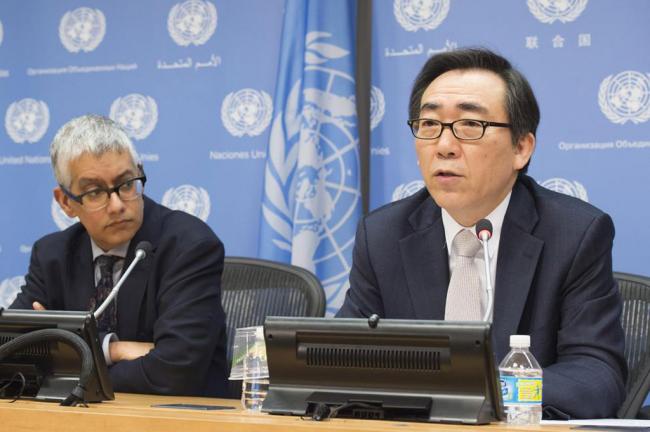
Outlining the intergovernmental advisory board’s objectives, Cho Tae-yul, the Permanent Representative of the Republic of Korea to the UN, told journalists in New York that he is “very much encouraged” by the enthusiasm among Member States for great international cooperation which “bodes very well for the Peacebuilding Commission.”
He detailed a number of priorities, including building on progress achieved in strengthening partnerships with regional and sub-regional groups.
“They are better poised to understand the root causes,” Cho said, adding that he is personally in support of stronger regional cooperation, particularly in Africa, where all six of the countries currently on the Peacebuilding Commission (PBC) agenda are located. Those countries are: Burundi; Sierra Leone; Guinea; Guinea-Bissau; Liberia; and Central African Republic.
In addition to country-specific work, the Commission also works thematically, on issues such as institution building, and enhancing the participation of women and youth.
The PBC will also this year continue to work on becoming a “more transparent, accountable and flexible body” through the use of new working methods. A number of new improvements were introduced just this morning, Cho said.
Created in 2005, the PBC supports a country through all stages of a conflict, including post-conflict recovery and socio-economic development. It sits between the UN Security Council, whose 15 members are primarily tasked with maintaining peace and security in the world; the General Assembly, whose membership includes all 193 Member States; and the Economic and Social Council, or ECOSOC, which works with the 14 specialized UN agencies.
It works closely with regional bodies such as the African Union, European Union and the Organization of the Islamic Conference, and representatives from the countries who are the top financial and troop contributors to the UN, as well as from the World Bank and the International Monetary Fund.
Increased financial support for the Peacebuilding Fund, which has allocated $623 million since its creation at the end of 2015, is also a key priority for the year. Cho said that he has “started preliminary dialogue” with the World Bank to see how to secure the targeted annual figure of $100 million.
He is also working to “enhance the Fund through strategic partnerships” with the UN Development Programme (UNDP) and other partners.
The UN News Centre highlighted the work of the PBC and the Peacebuilding Fund in a feature series this past August. Travel with us to Mali to see how the Fund is helping communities come back together after war.
UN Photo/Eskinder Debebe
Source: www.justearthnews.com
Support Our Journalism
We cannot do without you.. your contribution supports unbiased journalism
IBNS is not driven by any ism- not wokeism, not racism, not skewed secularism, not hyper right-wing or left liberal ideals, nor by any hardline religious beliefs or hyper nationalism. We want to serve you good old objective news, as they are. We do not judge or preach. We let people decide for themselves. We only try to present factual and well-sourced news.
Support objective journalism for a small contribution.


