


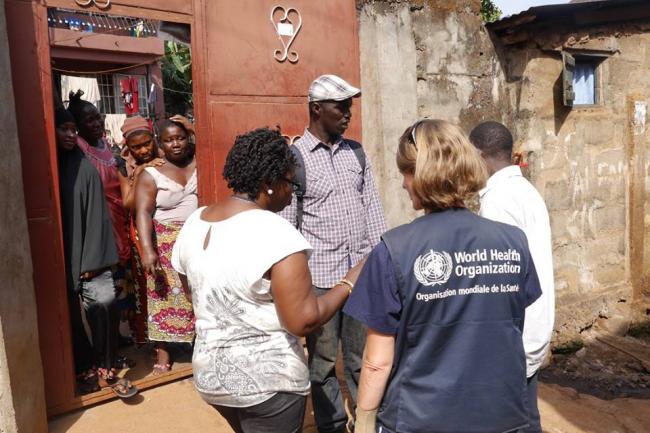
Ebola outbreak still a global emergency despite drop in cases: WHO
During the fifth meeting of the WHO’s International Health Regulations (IHR) Emergency Committee yesterday, the body determined that Ebola continued to constitute a ‘Public Health Emergency of International Concern’ and recommended the extension of all previous temporary recommendations.
Deliberating on whether or not Ebola constituted a public health emergency, the Committee reviewed developments since its last meeting on 20 January, it noted further improvements in prevention and control activities across West Africa, including in contact tracing. Observing declines in Liberia, Sierra Leone and Guinea, the virus appeared to have reduced its spread.
“These three IHR States Parties provided updates and assessment of the Ebola outbreak, in terms of the epidemiological situation and the status and performance of exit screening and contact tracing,” said a statement by the Emergency Committee.
While recognizing the progress achieved by all three countries, the Committee emphasized that there is no place for complacency, and reinforced the importance of community engagement in the UN-backed goal of “getting to zero.”
The rapid interruption of transmission remained the primary goal of the Committee, which expressed continued concern over recent health care worker infections and reaffirmed the importance of rigorously applying appropriate prevention and control measures.
A recent case of possible infection after sexual contact with an Ebola survivor months after recovery became the focus of a discussion on sexual transmission with the Committee welcoming ongoing research in this area and urging its acceleration.
The statement also voiced concern over additional health measures – such as quarantining returning travellers, refusing entry, cancelling flights and closing borders – as significantly interfering with international travel and negatively impacting both response and recovery efforts.
Although reports that some countries have recently rescinded these measures and certain regional airlines resumed flights to affected countries, about 40 nations still implement the additional procedures and a number of carriers have yet to resume flights to these States.
Concluding that Ebola continued to be a Public Health Emergency, the Committee recommended that previous temporary recommendations be extended and provided additional advice to the WHO Director-General in accordance with the IHR.
The statement strongly reiterated the need for continued exit screenings in the three affected countries, which must be maintained for at least 42 days after the last case had twice tested negative for Ebola.
It recommended these nations “to maintain exit screening until human-to-human transmission has stopped in the entire subregion” and “urged affected countries to provide WHO, on a monthly basis, with the number of people screened at international airports and the results of such screening.”
The Committee also reemphasized active surveillance, particularly in border areas – in addition to vigilance for new cases, tracing of known contacts and cross-border cooperation to share information and assets – and highlighted that social and cultural links, which cross national boundaries, must be taken into account when planning and implementing such activities.
Photo: WHO/D. Licona
Support Our Journalism
We cannot do without you.. your contribution supports unbiased journalism
IBNS is not driven by any ism- not wokeism, not racism, not skewed secularism, not hyper right-wing or left liberal ideals, nor by any hardline religious beliefs or hyper nationalism. We want to serve you good old objective news, as they are. We do not judge or preach. We let people decide for themselves. We only try to present factual and well-sourced news.
Support objective journalism for a small contribution.


