


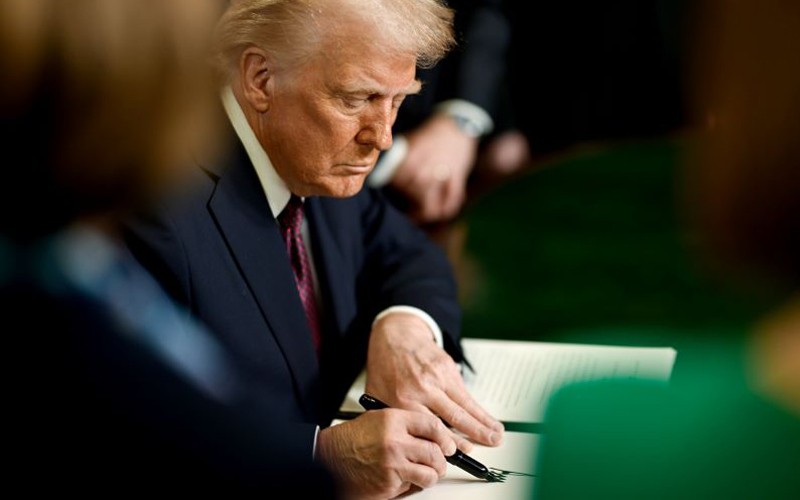
Donald Trump may impose the Insurrection Act, a martial law-type order, on April 20
Washington DC/IBNS: One of the first executive orders that Donald Trump signed when he returned to the White House as the President of America on January 20 was to declare a "national emergency" along the United States' southern border.
That order had a clause attached that President Trump might "invoke the Insurrection Act of 1807" and possibly deploy the military on US soil on April 20, which is ninety days after the executive order was signed.
The clause in President Trump's executive order on January 20 stated: "Within 90 days of the date of this proclamation, the Secretary of Defence and the Secretary of Homeland Security shall submit a joint report to the President about the conditions at the southern border of the United States and any recommendations regarding additional actions that may be necessary to obtain complete operational control of the southern border, including whether to invoke the Insurrection Act of 1807."
According to the Insurrection Act of 1807, the President of the United States may permit the deployment of the military and the US National Guard to ensure that the law is enforced in certain conditions and situations.
The law empowers the military to completely suppress any rebellion, uprising, or any act of violence or resistance, including that by citizens.
The Insurrection Act has the power to override the Posse Comitatus Act, which is normally in place at all times and prohibits the US military from participating or interfering in any civil law enforcement.
It also gives the US President - the commander-in-chief of the US armed forces - complete powers to decide if, when, and where to deploy US troops within the United States of America.
The Insurrection Act, however, is somewhat different from martial law.
While martial law gives complete control of administration and running of the affairs of the state to a military general, usually the chief of defence staff or the army chief, the Insurrection Act keeps the powers of the state and administration with the US President, who selectively uses military powers to enforce law and order.
Support Our Journalism
We cannot do without you.. your contribution supports unbiased journalism
IBNS is not driven by any ism- not wokeism, not racism, not skewed secularism, not hyper right-wing or left liberal ideals, nor by any hardline religious beliefs or hyper nationalism. We want to serve you good old objective news, as they are. We do not judge or preach. We let people decide for themselves. We only try to present factual and well-sourced news.
Support objective journalism for a small contribution.


