


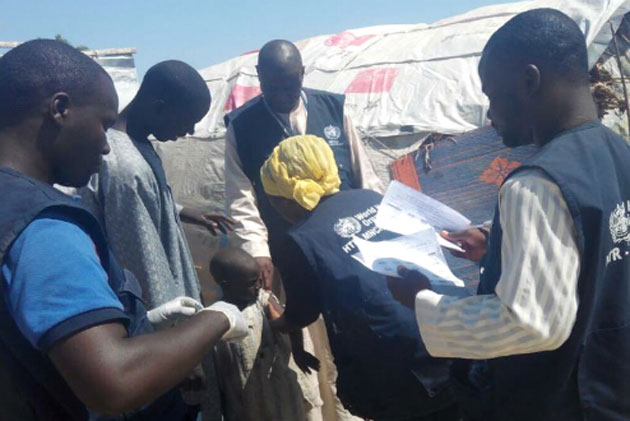
Despite progress, hundreds of children still die of measles every day – UN-backed report
“Making measles history is not mission impossible,” said Robin Nandy, chief of immunization at the UN Children’s Fund (UNICEF), in a joint news release on the report, which was authored and released by UNICEF, the World Health Organization (WHO), Gavi, the Vaccine Alliance, and the Centers for Disease Control and Prevention (CDC).
“We have the tools and the knowledge to do it; what we lack is the political will to reach every single child, no matter how far. Without this commitment, children will continue to die from a disease that is easy and cheap to prevent,” Nandy added.
According to the report, mass measles vaccination campaigns and a global increase in routine measles vaccination coverage saved an estimated 20.3 million young lives between 2000 and 2015.
But progress has been uneven. In 2015, about 20 million infants missed their measles shots and an estimated 134,000 children died from the disease. The Democratic Republic of the Congo, Ethiopia, India, Indonesia, Nigeria and Pakistan account for half of the unvaccinated infants and 75 per cent of the measles deaths.
“It is not acceptable that millions of children miss their vaccines every year. We have a safe and highly effective vaccine to stop the spread of measles and save lives,” said Dr. Jean-Marie Okwo-Bele, Director of WHO’s Department of Immunization, Vaccines and Biologicals.
“This year, the region of the Americas was declared free of measles – proof that elimination is possible. Now, we must stop measles in the rest of the world. It starts with vaccination,” he said.
The news release said that measles, a highly contagious viral disease that spreads through direct contact and through the air, is one of the leading causes of death among young children globally. It can be prevented with two doses of a safe and effective vaccine.
Measles outbreaks continue to be a serious challenge in numerous countries – caused by gaps in routine immunization and in mass vaccination campaigns. In 2015, large outbreaks were reported in Egypt, Ethiopia, Germany, Kyrgyzstan and Mongolia. The outbreaks in Germany and Mongolia affected adolescents and young adults as well.
Measles also tends to flare up in countries in conflict or humanitarian emergencies due to the challenges of vaccinating every child. Last year, outbreaks were reported in Nigeria, Somalia and South Sudan.
Photo: WHO/P. Ajello
Source: www.justearthnews.com
Support Our Journalism
We cannot do without you.. your contribution supports unbiased journalism
IBNS is not driven by any ism- not wokeism, not racism, not skewed secularism, not hyper right-wing or left liberal ideals, nor by any hardline religious beliefs or hyper nationalism. We want to serve you good old objective news, as they are. We do not judge or preach. We let people decide for themselves. We only try to present factual and well-sourced news.
Support objective journalism for a small contribution.


