


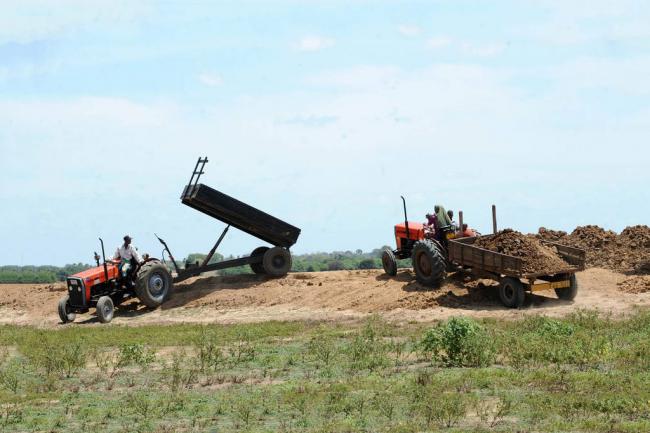
Country-level action 'new frontier' for tackling soil pollution – UN agriculture agency
Soil pollution due to human activities that leave excess chemicals in soils took centre stage at the 5th Global Soil Partnership (GSP) Plenary Assembly held at the Food and Agriculture Organization's (FAO) headquarters this week in Rome.
“Soil pollution is an emerging problem, but, because it comes in so many forms, the only way we can reduce knowledge gaps and promote sustainable soil management is to intensify global collaboration and build reliable scientific evidence,” said Ronald Vargas, FAO soils officer and Secretary of the GSP.
Excess nitrogen and trace metals such as arsenic, cadmium, lead and mercury can impair plant metabolism and cut crop productivity, ultimately putting pressure on arable land. When they enter the food chain, such pollutants also pose risks to food security, water resources, rural livelihoods and human health, underscored FAO.
“The GSP Plenary Assembly is a unique, neutral and multi-stakeholder platform to discuss global soil issues, to learn from good practices, and to deliberate on actions to secure healthy soils for an effective provision of ecosystem services and food for all,” said Maria Helena Semedo, FAO Deputy Director-General, Climate and Natural Resources. “Action at the country level is the new frontier.”
The Plenary Assembly endorsed three new initiatives aimed at facilitating information exchange: the Global Soil Information System; the Global Network of Soil Laboratories, set up to coordinate and standardize measurement across countries; and the International Network of Black Soils, launched to increase knowledge about the world's most fertile agricultural soils, which are also known for their high carbon content.
Soil pollution under scrutiny
The term soil pollution refers to the presence in soils of chemicals that are either out of place or at higher-than-normal concentrations. It is an insidious risk because it is harder to observe than some other soil degradation processes, such as erosion.
Agricultural inputs such as fertilizers, herbicides and pesticides – and antibiotics contained in animal manure – are major potential pollutants, posing special challenges due to the fast-changing chemical formulas employed.
The GSP endorsed a global symposium on soil contamination and pollution, for April 2018, and supported data networks to share information and harmonize standards to ease the burden.
Black soils
“Black soils” are far from uniform. The new International Network of Black Soils defines them as containing at least 25 centimetres of humus and with soil organic carbon content above two per cent; by this definition they cover about 916 million hectares, or seven per cent of the world's ice-free land surface.
The Network will promote their conservation and long-term productivity by producing analytic reports and serving as a platform for knowledge sharing and technical cooperation.
Photo: FAO
Source: www.justearthnews.com
Support Our Journalism
We cannot do without you.. your contribution supports unbiased journalism
IBNS is not driven by any ism- not wokeism, not racism, not skewed secularism, not hyper right-wing or left liberal ideals, nor by any hardline religious beliefs or hyper nationalism. We want to serve you good old objective news, as they are. We do not judge or preach. We let people decide for themselves. We only try to present factual and well-sourced news.
Support objective journalism for a small contribution.


