


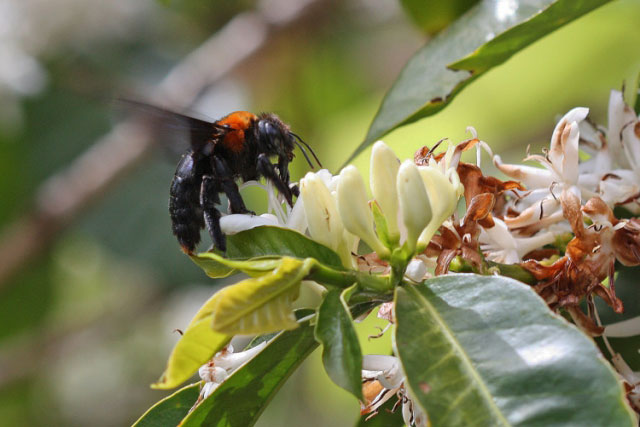
Countries urged to prioritize protection of pollinators to ensure food security at UN biodiversity conference
“Pollinators affect all of us. The food that we eat like our fruits and vegetables, our coffee and chocolate, all rely on pollinators. However, pollinators are facing many challenges, from intensive agriculture, pesticides, climate change, which are putting a lot of pressure on them,” said Simon Potts Professor at the University of Reading in the United Kingdom, who is the co-chair of a major report on pollinators being discussed in Cancun, Mexico, on Tuesday at the 13th Conference of the Parties of the Convention on Biological Diversity (CBD), also known as COP 13.
“There are many solutions and policies that countries can adopt to protect pollinators, so the trick here in Cancun is for countries to take these ideas and really make them work,” he added.
According to the global assessment on pollinators produced by the Intergovernmental Science-Policy Platform on Biodiversity and Ecosystem Services (IPBES), 75 per cent of our food crops and nearly 90 per cent of wild flowering plants depend to some extent on animal pollination, which is the transfer of pollen between the male and female parts of flowers to enable fertilization and reproduction.
In addition, the annual value of global crops that depend on pollinators is estimated to be worth $577 billion.
Without pollinators, crops such as coffee, cacao and apples would drastically suffer, and changes in global crop supplies could increase prices to consumers and reduce profits to producers, resulting in a potential annual net loss of economic welfare of $160 billion to $191 billion globally.
Beyond food, pollinators also contribute directly to medicines, biofuels, fibres like cotton and linen, and construction materials.
“Pollination services are an 'agricultural input' that ensures the production of crops. All farmers, especially family farmers and smallholders around the world, benefit from these services,” said José Graziano da Silva, Director-General of the Food and Agriculture Organization of the (FAO) in the report's foreword.
“Improving pollinator density and diversity has a direct positive impact on crop yields, consequently promoting food and nutrition security. Hence, enhancing pollinator services is important for achieving the Sustainable Development Goals (SDGs), as well as for helping family farmers' adaptation to climate change.”
The majority of pollinator species are wild, including more than 20,000 species of bees, some species of flies, butterflies, moths, wasps, beetles, birds, bats and other vertebrates. Currently, 16 per cent of vertebrate pollinators, and more than 40 per cent of invertebrate pollinators, are facing global extinction.
The report, which was released earlier this year, offers a number of solutions to halt the decline in pollinators. Some of these include: the promotion of sustainable agriculture, creating greater diversity of pollinator habitats in agricultural and urban landscapes, crop rotation, using indigenous local knowledge and decreasing use of pesticides.
Recognizing that this is a pressing issue, 11 European countries have already announced a 'Coalition of the willing' at COP13, which seeks to implement national pollinator strategies, consistent with IPBES report and share new approaches, innovations and best practices, as well as establish new partnerships to safeguard these valuable creatures.
Photo: FAO/Dino Martins
Source: www.justearthnews.com
Support Our Journalism
We cannot do without you.. your contribution supports unbiased journalism
IBNS is not driven by any ism- not wokeism, not racism, not skewed secularism, not hyper right-wing or left liberal ideals, nor by any hardline religious beliefs or hyper nationalism. We want to serve you good old objective news, as they are. We do not judge or preach. We let people decide for themselves. We only try to present factual and well-sourced news.
Support objective journalism for a small contribution.


