


 Cotton Economy
Cotton sustains more than 100 million families worldwide
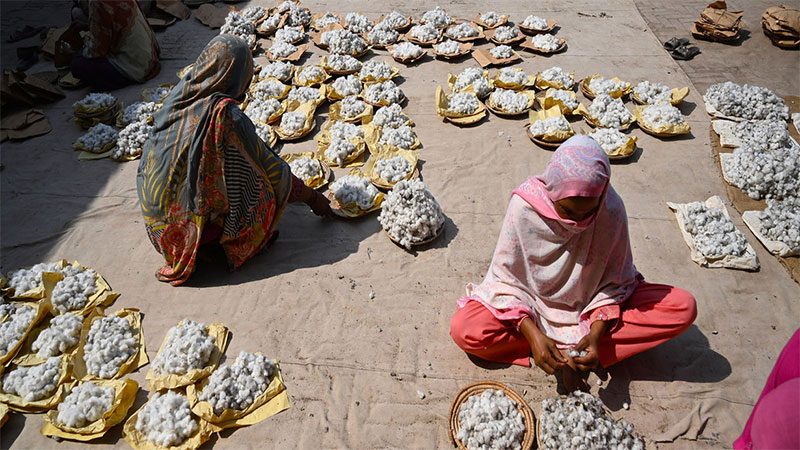
New York: A single metric tonne of cotton provides jobs for five people on average, often in some of the world’s most impoverished regions; that adds up around 100 million families across the globe.
To recognize these and other contributions, the United Nations is marking World Cotton Day, this Thursday.
Cotton is an important means of livelihood for millions of smallholders and attracts export revenues to some of the poorest countries. This makes the sector a key contributor to reaching the 2030 Agenda for Sustainable Development.
For the UN, this natural fabric “represents so much more than just a commodity”, it is “a life-changing product.”
Important source
Cotton is a major source of income for many rural laborers, including women. With this World Day, the UN wants to raise awareness of the critical role that cotton plays in economic development, international trade and poverty alleviation.
The initiative also wants to highlight the importance of sustained, inclusive and sustainable economic growth, full and productive employment, and decent work for all.
Resilient and multipurpose
As a crop resistant to climatic changes, cotton can be planted in dry and arid zones. It occupies just 2.1 per cent of the world’s arable land, but it meets 27 per cent of the world’s textile needs.
Around 80 per cent of cotton is used in the clothing industry, 15 per cent in home furnishings and the remaining 5 per cent mostly accounts for non-woven applications, such as filters and padding.
Almost nothing from cotton is wasted. In addition to textiles and apparel, food products can be derived from it, such as edible oil and animal feed from the seed.
Other uses have been developed recently, like using cotton-based filaments in 3D printers, because they conduct heat well, become stronger when wet, and are more scalable than materials like wood.
The ‘Cotton Four’
The idea for the World Day was born in 2019, when four cotton producers in sub-Saharan Africa – Benin, Burkina Faso, Chad and Mali, known as the Cotton Four -proposed a celebration on October 7, to the World Trade Organization.
With the UN officially recognizing the date, it became an opportunity to create awareness of the need of market access from least developed countries, to foster sustainable trade policies and to enable developing countries to benefit more from every step of the value chain.
For years, UN agencies have worked towards this goal.
For instance, since 2003, the International Trade Centre (ITC) and the World Trade Organization have helped the Cotton Four to improve production local processing capacity, as well as to discuss the trade reforms needed to address high trade barriers.
Another UN agency, FAO, has long offered developing countries technical and policy support. One example is the +Cotton project, a cooperation initiative with Brazil that helps Latin American producers with innovative farming methods.
Support Our Journalism
We cannot do without you.. your contribution supports unbiased journalism
IBNS is not driven by any ism- not wokeism, not racism, not skewed secularism, not hyper right-wing or left liberal ideals, nor by any hardline religious beliefs or hyper nationalism. We want to serve you good old objective news, as they are. We do not judge or preach. We let people decide for themselves. We only try to present factual and well-sourced news.
Support objective journalism for a small contribution.


