


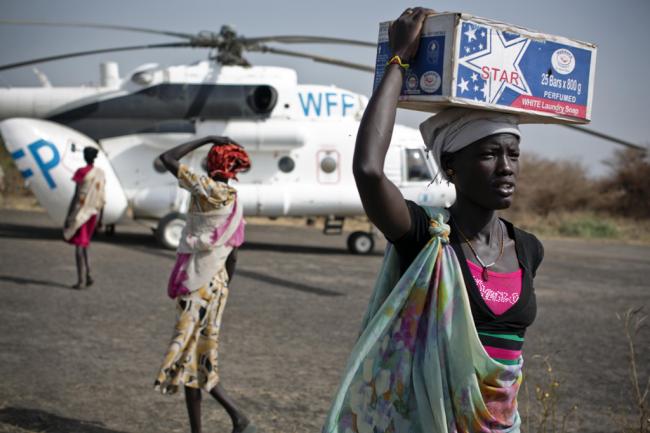
Cost of feeding hungry world surging due to conflicts and instability – UN agency
“More than anything else, the world needs to wake up, and end these wars and these conflicts, so we can make real progress in ending hunger,” said David Beasley, the Executive Director of the UN World Food Programme in a news release on Thursday.
“Around 800 million people – one in nine around the world – go to bed on an empty stomach. But man-made conflicts and other strife make it difficult to help those who need it most. Reducing these roadblocks would ease the path towards long-term solutions.”
In its report, World Food Assistance 2017: Taking Stock and Looking Ahead, WFP notes that its costs spiked by more than 140 per cent over a seven-year period – from $2.2 billion in 2009 to $5.3 billion in 2015.
The need for additional resources come amid significant changes to the international food assistance sector since 2009.
Within WFP, the share of assistance delivered as food declined from 54 per cent to less than 40 per cent. Conversely, the share of cash-based transfers surged from less than 1 per cent in 2009 to 20 per cent in 2016.
In this scenario, the WFP report argues that improvements such as more accessible and safe humanitarian access could reduce costs by almost $1 billion each year.
Furthermore, if the roughly 80 countries where the UN agency operates were better able to cope with climate-related, political, and economic shocks, another $2.2 billion annually could be saved.
And if food systems – the networks responsible for producing food, transforming it and ensuring that it reaches hungry people – could be improved in these countries, another $440 million could be saved annually.
“If solutions or improvements to these challenges were found, cost savings to WFP could be as high as $3.5 billion per year,” noted the UN agency.
Photo: UNICEF/Holt
Source: www.justearthnews.com
Support Our Journalism
We cannot do without you.. your contribution supports unbiased journalism
IBNS is not driven by any ism- not wokeism, not racism, not skewed secularism, not hyper right-wing or left liberal ideals, nor by any hardline religious beliefs or hyper nationalism. We want to serve you good old objective news, as they are. We do not judge or preach. We let people decide for themselves. We only try to present factual and well-sourced news.
Support objective journalism for a small contribution.


