

COP21: UN spotlights need to protect forests and agriculture to improve livelihoods
Many of the events on the second day of the global gathering in Paris, France took place in the context of the Lima-Paris Action Agenda (LPAA) – a joint undertaking by the Governments of Peru and France, the Office of UN Secretary-General Ban Ki-moon and the UN Framework Convention on Climate Change (UNFCCC), the organizer of the current conference, the 21st meeting of the Convention’s States Parties.
The Action Agenda was launched in December 2014 by the previous meeting of the UNFCCC parties in Lima, Peru.
As highlighted in a press release issued by UNFCCC, the LPAA aims to strengthen climate action beyond COP21, by “mobilizing robust global action towards low carbon and resilient societies and providing enhanced support to existing initiatives.”
During the two-week conference, 12 thematic focus events are being organized to expose how climate issues affect various sectors and to suggest relevant solutions to tackle them.
On Tuesday, with forests and agriculture taking center stage, leaders from governments, the private and public sectors, civil society and indigenous peoples voiced their environmental concerns.
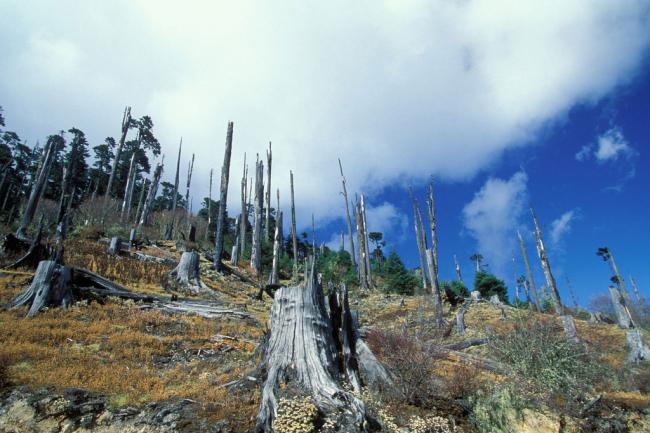
This included how agriculture, forestry and other land uses are responsible for nearly a quarter of all greenhouse gas emissions – about half of that from deforestation and forest degradation, mostly driven by demand for food and wood products and inequities and inefficiencies in the use of land for their production.
“Forest countries in partnership with other governments, the private sector and civil society are set for an increased international effort to eliminate natural deforestation and forest degradation in a few decades,” said Peru’s Minister of the Environment Manuel Pulgar-Vidal speaking at a press conference.
“The success of the LPAA and its action area on Forests relies on effective synergies between state and non-state actors, between investment and forest management – all together rallied behind sustainably managed forests as a common goal,” he added.
According to UN estimates, approximately one billion people depend directly on forests for their livelihoods and each year, approximately 12 million hectares of forest are destroyed. This loss of forest cover is said to be responsible for roughly 11 per cent of global greenhouse gas emissions.
Meanwhile, governments and organizations, including the UN Food and Agriculture Organization (FAO) and the International Fund for Agricultural Development (IFAD), announced six new cooperative initiatives that aim to protect the long-term livelihoods of millions of farmer and reduce greenhouse gas emissions.
The entities highlighted how agriculture is one of the sectors most seriously affected by extreme climate but it also accounts for 24 per cent of greenhouse gas emissions which cause climate change.
The initiatives focus on four key areas: soils in agriculture, the livestock sector, food losses and waste, and sustainable production methods and resilience of farmers.
The new partnerships are expected to deploy money and know-how across both developed and developing nations to help hard-pressed farmers become key actors in the global drive to achieve a low-carbon, climate-resilient future.
UNFCCC said today’s events reveal the “effective and concrete progress” that can be made when a wide, international set of stakeholders work together to build resilience and low-carbon systems of production in agricultural and food systems.
World Bank/Curt Carnemark/www.justearthnews.com
Support Our Journalism
We cannot do without you.. your contribution supports unbiased journalism
IBNS is not driven by any ism- not wokeism, not racism, not skewed secularism, not hyper right-wing or left liberal ideals, nor by any hardline religious beliefs or hyper nationalism. We want to serve you good old objective news, as they are. We do not judge or preach. We let people decide for themselves. We only try to present factual and well-sourced news.
Support objective journalism for a small contribution.