


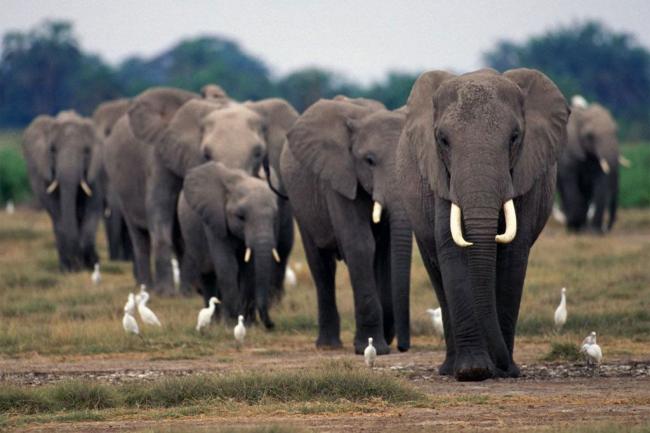
Cooperation vital to combating wildlife crime: UN Assembly President
“We need to strengthen our commitment and enhance cooperation among Member States, the United Nations system, NGOs and civil society to curb wildlife crime,” said Sam Kutesa (Uganda) as the Assembly commemorated World Wildlife Day.
“We should do more to promote adequate national legislation, improve intelligence sharing and border controls, strengthen global, regional and national enforcement, improve capabilities to combat poaching and illegal trafficking, among other initiatives," Sam said.
Kutesa underlined the impact that illegal trafficking, pointing to its effects on the resource base of local communities and entire nations, undermining human welfare, legitimate business and government institutions.
“It also compromises efforts towards sustainable development and poverty eradication,” he said.
“At the UN Conference on Sustainable Development (Rio+20) in 2012, Heads of State and Government recognized the economic, social and environmental impacts of illicit trafficking in wildlife," he added.
He described “worrisome” statistics on wildlife trafficking, with the 20,000 elephants and over 10,000 pangolins illegally slaughtered and trafficked in 2013 alone contributing to an illegal trade worth billions of dollars.
That was attracting organised criminal networks, as well as rebel and terrorist groups.
“There is growing recognition worldwide that trafficking in wildlife poses a serious security risk,” he said.
Those comments were echoed by Jan Eliasson, the UN Deputy Secretary-General, who also made remarks at the event to commemorate the Day.
“There is growing evidence of the increased involvement in this illicit and insidious trade by organized crime networks and non-State armed groups,” he said.
“Illegal wildlife trade has become a mushrooming transnational form of crime, following in the footsteps of other pernicious examples, such as trafficking in human beings, in drugs and in counterfeit items," he added.
Eliasson said the issue was a grave economic, social and security challenge and concern, and pointed to the threat it posed to all three pillars of the UN – peace and security, sustainable development and human rights.
He called for “swift action” to combat the illegal trade and outlined the work of the UN system to tackle it, including coordinated efforts by the UN Environment Programme (UNEP), the UN Development Programme (UNDP) and the UN Office on Drugs and Crime (UNODC) to promote alternative livelihoods, raise awareness, strengthen the rule of law and improve the data and evidence base for interventions.
Alongside the necessary enforcement efforts, he stressed the need to address the demand for illegally traded wildlife.
“Distorted demand is a key driver of the poaching of elephants and rhinos,” he said, calling for comprehensive and effective public information campaigns to raise awareness and knowledge.
“Wildlife products are widely used as medicines, food, building materials, furniture, cosmetics, clothing and accessories. Getting serious about wildlife crime means enrolling the support of all sectors of society involved in the production and consumption of wildlife products," he said.
Both Eliasson and Kutesa stressed that some progress was being made in combating illegal wildlife trade and that more would need to be done. Kutesa stressed that local communities must be encouraged to take a vested interest in protecting wildlife resources.
“Around the world, communities are dependent on wildlife; whether for sustenance, economic activities, or cultural identity,” he said, stressing the need to raise public awareness about the disastrous implications of wildlife crime and of efforts to promote wildlife preservation.
“Let us use this commemorative meeting to reflect on how we can effectively combat illegal wildlife trade in all its forms,” he said.
Photo: CITES
Support Our Journalism
We cannot do without you.. your contribution supports unbiased journalism
IBNS is not driven by any ism- not wokeism, not racism, not skewed secularism, not hyper right-wing or left liberal ideals, nor by any hardline religious beliefs or hyper nationalism. We want to serve you good old objective news, as they are. We do not judge or preach. We let people decide for themselves. We only try to present factual and well-sourced news.
Support objective journalism for a small contribution.


