


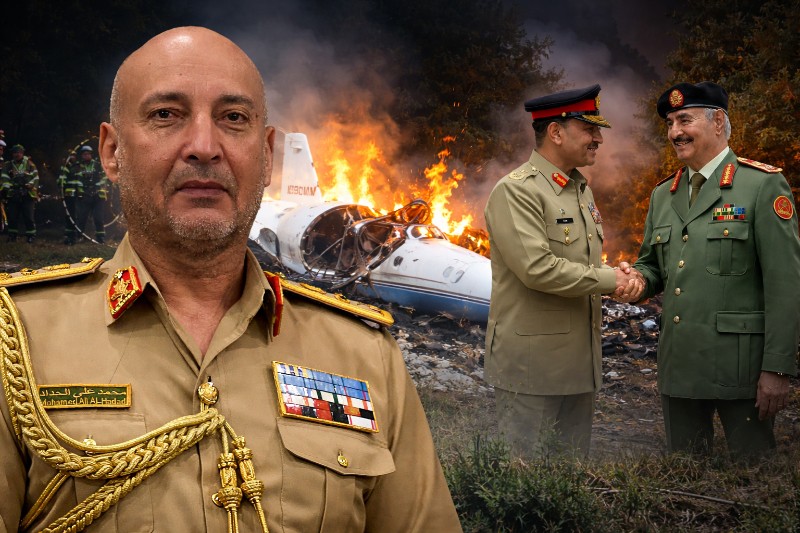
 Al-Haddad
Conspiracy clouds Libyan army chief’s death: Plane crash in Turkey follows Asim Munir's meeting with rebel Khalifa Haftar
Ankara/IBNS: Libya’s army chief Lieutenant General Mohamed Al-Haddad was killed in a plane crash near Turkey’s capital while returning from an official visit to Ankara, triggering intense speculation amid rapidly shifting regional military alliances.
The fatal incident occurred just days after Pakistan Army chief General Asim Munir held high-profile meetings with eastern Libyan commander Khalifa Haftar, raising questions over timing, motives, and geopolitics.
The Falcon 50 business jet lost contact shortly after take-off from Ankara’s Esenboga Airport on Tuesday night, killing Al-Haddad and four senior Libyan military officials.
🚨 BREAKING
— TRIDENT (@TridentxIN) December 23, 2025
An aircraft carrying Libya’s Chief of the General Staff has crashed near Ankara, Turkey.
Communication was lost shortly after take-off.
Libyan PM confirms the death of Army Chief Mohammed Ali Ahmed al-Haddad.
🇱🇾 باللهجة الليبية:
رئيس الوزراء الليبي أكد وفاة رئيس… pic.twitter.com/Akxb10WaXh
Turkish and Libyan authorities have described the crash as an accident, but the broader political context has fueled conspiracy theories across regional and diplomatic circles.
Death comes at a politically charged moment
Al-Haddad’s death comes at a particularly sensitive juncture for Libya, which remains divided between rival power centres in Tripoli and Benghazi.
Only days earlier, Pakistan and Libya reportedly finalised a military equipment deal worth more than $4 billion, according to media reports.
The agreement followed meetings between General Asim Munir and senior Libyan military leaders aligned with Khalifa Haftar in eastern Libya.
#PHOTOS
— Libya Review (@LibyaReview) December 17, 2025
Libyan Army General Khalifa Haftar meets Pakistani Army Chief Asim Munir in Benghazihttps://t.co/PzK4AXbBsr pic.twitter.com/QvDx3hIKb4
The deal, described by Pakistani officials as strategically significant, has drawn scrutiny because it allegedly violates a long-standing United Nations arms embargo on Libya.
The officials cited in the report spoke on condition of anonymity due to the sensitivity of the discussions.
Munir–Haftar engagement raises eyebrows
During his interaction with Libyan commanders in Benghazi, Munir reportedly stressed the importance of fearlessness in nation-building and claimed Pakistan relied largely on indigenous defence technology during its recent military confrontation with India.
He also asserted that Pakistan’s forces had destroyed advanced Indian assets, including Rafale jets and the S-400 air defence system—claims that India has categorically rejected.
🇱🇾🇵🇰 Lt Gen Saddam Haftar meets Field Marshal Asim Munir in Benghazi
— Global Defense Insight (@Defense_Talks) December 19, 2025
Deputy Commander-in-Chief of the Libyan Armed Forces for the Eastern and Southern regions, Lt Gen Saddam Haftar, held a meeting with Pakistan’s Army Chief, Field Marshal Asim Munir, at the Libyan National… pic.twitter.com/Wtmeavi2qA
Munir further told Saddam Khalifa Haftar, deputy commander of the Libyan National Army, that Pakistan was prepared to share military technology with Libya.
He described Libya as a “brotherly nation” and emphasised the role of strong armed forces in ensuring national survival.
Al-Haddad and Haftar: Rivals on opposite sides
Lieutenant General Al-Haddad was the army chief under Libya’s UN-recognised Government of National Unity based in Tripoli.
He was widely regarded as a key military opponent of Khalifa Haftar, whose eastern-based Libyan National Army has repeatedly challenged the authority of the internationally recognised government.
Al-Haddad’s forces actively resisted Haftar’s earlier military campaigns, including the failed offensive to seize Tripoli.
While Haftar is viewed by many international actors as a strongman or warlord, his supporters portray him as a stabilising force backed at various times by Egypt, the UAE, and Russia.
Questions over timing and motive
The sudden death of a senior military rival, so soon after high-stakes foreign military negotiations involving Haftar’s camp, has inevitably raised suspicions.
Analysts note that Al-Haddad’s removal could shift internal military balances within Libya, potentially benefiting eastern factions at a time of renewed international engagement.
🚨 Wreckage of Libya-bound private jet carrying Libyan army chief that departed Ankara has been found in Ankara’s Haymana district: Turkish interior minister https://t.co/rNv8JOpyfr pic.twitter.com/uejNIaPwdR
— Anadolu English (@anadoluagency) December 23, 2025
While no evidence has emerged to suggest foul play, the coincidence of events has sparked intense debate in Libyan media and political circles, with some questioning whether the crash was purely accidental or part of a broader regional power struggle.
What happened to the aircraft?
According to Turkish authorities, the jet departed Ankara at around 8:10 pm local time and lost contact roughly 40 minutes later.
Interior Minister Ali Yerlikaya said the aircraft issued an emergency landing request near the Haymana district before communication ceased at approximately 8:52 pm.
Turkish broadcaster CNNTurk reported that the aircraft had declared an electrical malfunction and requested permission to return to Esenboga Airport.
The jet, which reportedly had a French crew of three, disappeared from radar shortly afterwards.
Full investigation underway
Turkey’s Justice Minister Yilmaz Tunc confirmed that a comprehensive investigation has been launched, with authorities examining all aspects of the incident.
Libyan Prime Minister Abdulhamid al-Dbeibah described the crash as a “tragic accident” and expressed condolences to the families of the victims.
Uçağın Düştüğüne Dair Görüntüler.
— Ajans Haber12 (@Ajans_Haber12) December 23, 2025
Ankara'da uçak kazası: Uçuşlar Durduruldu.
Libya Genelkurmay Başkanı Muhammed Ali Al-Haddad'ı taşıyan uçak Ankara’dan kalktıktan kısa bir süre sonra düştü.
Uçağın Haymana Kesik Kavak Köyü'ne Yakın Bir Yere Düştüğü Belirtildi. pic.twitter.com/GHfT0N24ti
The other deceased officials included Major General Al-Fitouri Ghreibel, Chief of Staff of the Ground Forces; Brigadier General Mahmoud Al-Qatioui, head of the Military Manufacturing Authority; adviser Mohamed Al-Asawi Diab; and media office photographer Mohamed Omar Ahmed Mahjoub.
Earlier the same day, Turkey’s armed forces had formally received Al-Haddad with a military ceremony in Ankara, where he met Turkish Chief of the General Staff General Selcuk Bayraktaroglu, underscoring the high-level nature of his visit.
A death that raises more questions than answers
As investigations continue, Al-Haddad’s death has left Libya’s already fragile political and military landscape even more uncertain.
With regional powers deepening their involvement and rival factions vying for advantage, the crash has become more than a tragic accident—it has become a flashpoint for speculation, suspicion, and geopolitical intrigue.
Who was Mohammed al-Haddad?
Political observers and analysts described al-Haddad as a rare unifying figure in Libya’s deeply fragmented security landscape.
A career soldier, he supported the 2011 uprising against Gaddafi but later gained respect for resisting pressure from powerful militias that dominate large parts of western Libya.
Al-Haddad was widely seen as an advocate for reconciliation between Libya’s rival administrations in Tripoli and Benghazi.
Many Libyans viewed him as a stabilising force and a credible partner in negotiations aimed at ending years of conflict and restoring unified state institutions.
He had served as Libya’s chief of general staff since August 2020, having been appointed by then-Prime Minister Fayez al-Sarraj.
Millî Savunma Bakanı Yaşar Güler, Genelkurmay Başkanı Orgeneral Selçuk Bayraktaroğlu’nun davetlisi olarak Ankara’ya gelen Libya Genelkurmay Başkanı Orgeneral Muhammed Ali Al-Haddad’ı kabul etti.
— T.C. Millî Savunma Bakanlığı (@tcsavunma) December 23, 2025
Kabulde Genelkurmay Başkanı Orgeneral Selçuk Bayraktaroğlu ve Kara Kuvvetleri… pic.twitter.com/VgBiAxgEvK
During his tenure, he worked closely with international partners, including Turkey, which has provided military training, logistical support, and strategic backing to the Tripoli-based government.
Turkey and Libya have deepened ties in recent years, signing agreements on maritime boundaries and energy exploration, while Ankara has also sought to expand contacts with Libya’s eastern faction under its “One Libya” policy.
The sudden death of Mohammed al-Haddad not only removes a key military leader but also injects new uncertainty into Libya’s already fragile political and security environment, as investigations continue into one of the most significant aviation tragedies involving the country’s leadership in recent years.
Support Our Journalism
We cannot do without you.. your contribution supports unbiased journalism
IBNS is not driven by any ism- not wokeism, not racism, not skewed secularism, not hyper right-wing or left liberal ideals, nor by any hardline religious beliefs or hyper nationalism. We want to serve you good old objective news, as they are. We do not judge or preach. We let people decide for themselves. We only try to present factual and well-sourced news.
Support objective journalism for a small contribution.


