


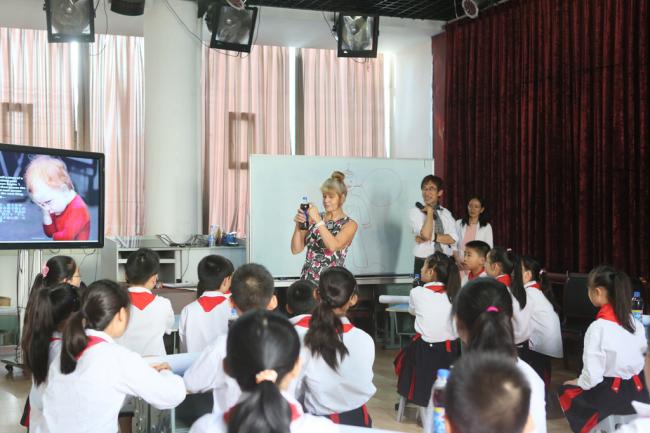
Children in 15 of 26 industrial countries lack access to rights education: UN survey
The report, Teaching and learning about child rights: A study of implementation in 26 countries, also found that none of the countries studied ensure that all teachers are trained in child rights and are familiar with the Convention on the Rights of the Child.
“This report is a wakeup call for countries that have ratified [the Convention] to take the necessary measures to ensure systematic implementation of a child’s right to learn about her or his rights,” said Gérard Bocquenet of UNICEF.
The report, commissioned by UNICEF, analyzed the situation and identified challenges around child rights education in 26 industrialized countries and territories, including to what extent child rights are embedded in formal education settings and teacher training.
The Convention, which applies in all of the 26 countries and territories, requires a formal commitment to make its principles widely known to adults and children alike.
However, 25 years after the adoption of that document – the most widely ratified UN treaty – much work remains to be done to ensure that child rights are implemented in schools, including in industrialized countries. Implementing systematic child rights education in schools is therefore essential to realize the Convention.
The 15 countries and territories where children lack systematic access to child rights education in curricula are Australia, Austria, Belgium, Canada, Denmark, Germany, Hong Kong, Ireland, Israel, Italy, Netherlands, New Zealand, Scotland, Spain and United States.
The report also shows that seven countries –Austria, Belgium, Canada, Germany, Israel, Italy and United States – include some child rights education in school curricula but fail to do so nationwide.
Only three out of 26 countries explicitly and consistently monitor child rights education. Even when children learn about rights they may not learn about the Convention or about key aspects of what it means to have rights.
Despite these findings, the research highlights many examples of how UNICEF and civil society partners are successfully addressing all aspects of child rights education at different levels in all the countries analysed.
This is being done through policy, curriculum reform, and teacher training, as well as by embedding child rights into monitoring and inspection frameworks and by transforming the whole school environment to become rights-respecting.
“A key challenge is to ensure that these examples of good practice are aligned and fully integrated throughout education systems,” said Marta Arias, UNICEF Advocacy and Policy Specialist.
She added, “The report will guide countries in this task and help them to identify the best way forward within their national context.”
Photo: UNICEF China/Guo Xiaoping
Support Our Journalism
We cannot do without you.. your contribution supports unbiased journalism
IBNS is not driven by any ism- not wokeism, not racism, not skewed secularism, not hyper right-wing or left liberal ideals, nor by any hardline religious beliefs or hyper nationalism. We want to serve you good old objective news, as they are. We do not judge or preach. We let people decide for themselves. We only try to present factual and well-sourced news.
Support objective journalism for a small contribution.


