


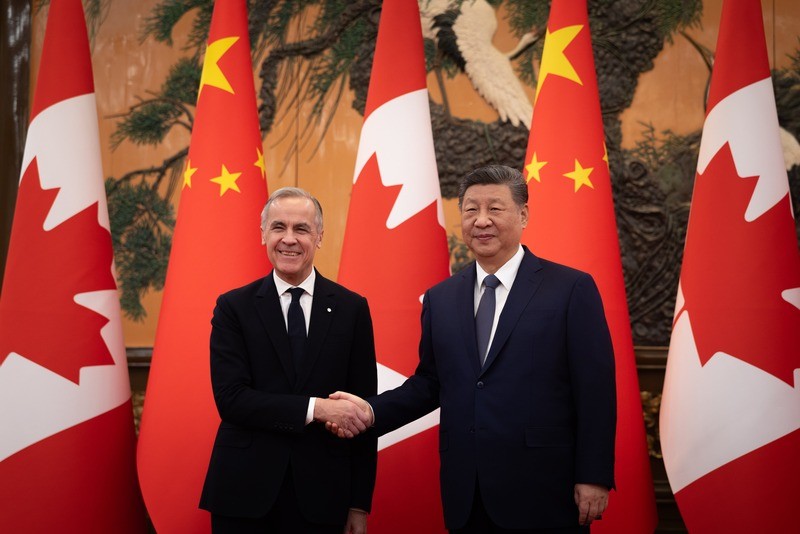
Carney, Xi announce new Canada–China strategic partnership during Beijing talks
Beijing: Canadian Prime Minister Mark Carney met Chinese President Xi Jinping on Friday, as the two leaders announced a new Canada–China strategic partnership amid shifting global economic and security conditions.
"A pleasure to meet with President Xi in Beijing," Carney wrote on X.
"Canada and China are forging a new strategic partnership. We’re leveraging our strengths—focusing on trade, energy, agriculture, seafood, and other areas where we can make massive gains for both our peoples."
A pleasure to meet with President Xi in Beijing.
— Mark Carney (@MarkJCarney) January 16, 2026
Canada and China are forging a new strategic partnership. We’re leveraging our strengths — focusing on trade, energy, agriculture, seafood, and other areas where we can make massive gains for both our peoples. pic.twitter.com/C1YGTF5w7J
Following talks, Carney and Xi issued a joint statement outlining the framework of the partnership.
Electric vehicle market access
As part of the agreement, Canada will allow up to 49,000 Chinese electric vehicles to enter the Canadian market at a most-favoured-nation tariff rate of 6.1%.
The volume represents imports prior to recent trade frictions and accounts for less than 3% of Canada’s new vehicle market.
The government expects the move to encourage joint-venture investments in Canada’s auto manufacturing and electric vehicle supply chain.
Officials said more than half of the imported vehicles could be priced below $35,000 within five years.
Trade and agri-food market access
China remains Canada’s second-largest export market.
Canada expects China to lower tariffs on Canadian canola seed to about 15% by March 1, 2026, down from current levels of roughly 85%.
China is a major market for Canadian canola, valued at about $4 billion.
Canada also expects canola meal, lobsters, crabs and peas to be exempt from certain trade measures through at least the end of 2026. The government said the measures could unlock nearly $3 billion in export orders.
Energy and clean technology cooperation
A central pillar of the partnership is cooperation in energy, clean technology and climate competitiveness.
Both countries agreed to expand collaboration in conventional and clean energy, including batteries, solar, wind and energy storage, with a focus on reducing emissions and improving energy security.
Export growth target
Canada has set a target to increase exports to China by 50% by 2030. Both sides discussed boosting two-way investment in clean energy, agri-food, wood products and technology to support that goal.
What's next?
Carney is expected to return to China for the 2026 APEC Leaders’ Summit.
Canada said it would engage with China during its 2026 Asia-Pacific Economic Cooperation presidency and noted China’s support for Canada’s bid to host the 2029 APEC summit.
This visit follows Carney’s first official meeting with Xi in October and marks the first trip to China by a Canadian prime minister since 2017.
Support Our Journalism
We cannot do without you.. your contribution supports unbiased journalism
IBNS is not driven by any ism- not wokeism, not racism, not skewed secularism, not hyper right-wing or left liberal ideals, nor by any hardline religious beliefs or hyper nationalism. We want to serve you good old objective news, as they are. We do not judge or preach. We let people decide for themselves. We only try to present factual and well-sourced news.
Support objective journalism for a small contribution.


