


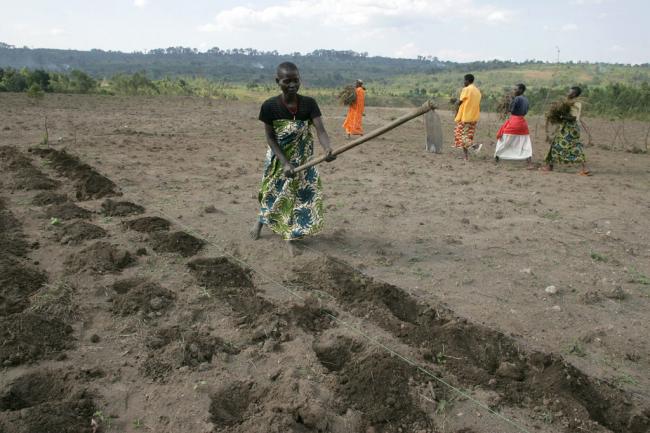
Caring for the planet starts with ‘the ground we walk on;’ UN says on World Soil Day
New York, Dec 6(Just Earth News): Soil is a major carbon storage system, essential for sustainable agriculture and climate change mitigation, the United Nations agriculture agency said on Tuesday, launching on World Soil Day a comprehensive global map showing the amount of carbon stocks contained in soil.
“Soil is the foundation of agriculture , it is where food begins,” said Maria Helena Semedo, Deputy Director-General of the UN Food and Agriculture Organization (FAO).
“Maintaining the soil’s important functions and ecosystem services to support food production and increase resilience to a changing climate calls for sustainable soil management practices,” she added.
Soil organic matter, with carbon as its main component, is crucial to soil health and fertility, water infiltration and retention as well as food production.
The world’s soils act as the largest terrestrial carbon sink, reducing greenhouse gases. Intensifying its role could significantly offset the rapid rise of carbon dioxide in the atmosphere.
In an historic decision on agriculture, the 2017 UN Climate Change Conference in Bonn (COP23 ) recognized the need for improved soil carbon, soil health and soil fertility. The Global Soil Organic Carbon Map, the most comprehensive to date, illustrates the amount of organic carbon stock in the first 30 cm of soil – revealing natural areas with high carbon storage that require conservation along with regions where further sequestration would be possible.
This information can prove a powerful tool to guide decision-making on practices aimed to preserve and increase the current soil carbon stocks – helping win the fight against climate change.
The map shows that globally the first 30 cm of soil contains around 680 billion tons of carbon – almost double the amount present in our atmosphere.
The degradation of one third of the world’s soils has already prompted an enormous release of carbon into the atmosphere. Restoring these soils can remove up to 63 billion tons of carbon, significantly reducing the effects of climate change.
FAO's Intergovernmental Technical Panel on Soils supported the map’s development, including by putting together the national carbon maps of more than 100 countries, making a concrete contribution towards Sustainable Development Goal (SDG) 15, Life on Earth.
The next step is for countries to monitor their national soil information systems for organic carbon levels to make evidence-based decisions on how to manage and monitor their soils.
Photo: FAO/Giulio Napolitano
Source: www.justearthnews.com
Support Our Journalism
We cannot do without you.. your contribution supports unbiased journalism
IBNS is not driven by any ism- not wokeism, not racism, not skewed secularism, not hyper right-wing or left liberal ideals, nor by any hardline religious beliefs or hyper nationalism. We want to serve you good old objective news, as they are. We do not judge or preach. We let people decide for themselves. We only try to present factual and well-sourced news.
Support objective journalism for a small contribution.


