


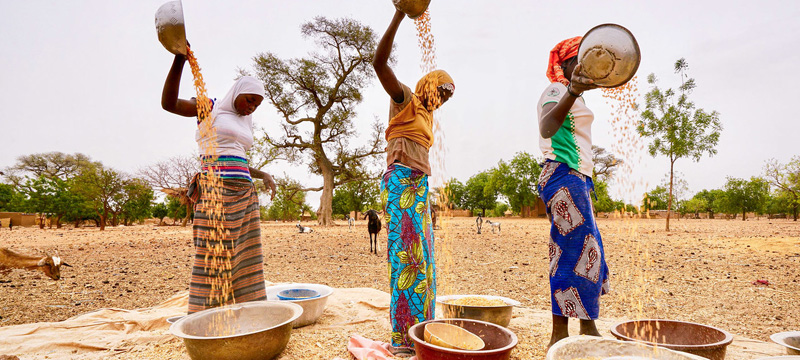
 Burkina Faso
Burkina Faso ‘one step short of famine’, warns UN food relief agency
New York: Unless access is urgently granted to humanitarian organizations, thousands in the Central Sahel will be “pushed into further destitution”, the UN emergency food relief agency warned on Monday.
Ahead of Tuesday’s High-Level Ministerial Conference on the Central Sahel in the Danish capital Copenhagen, the World Food Programme (WFP) sounded the alarm that catastrophic levels of hunger could hit parts of Burkina Faso, Mali and Niger.
‘Tragic’ food insecurity spike
Violence and insecurity have pushed 7.4 million people in the Central Sahel region of West Africa into acute hunger, according to WFP.
Additionally, the number of internally displaced people has risen from 70,000 two years ago to nearly 1.6 million today – including over 288,000 in Mali, more than 265,000 in Niger and over one million in Burkina Faso, which is now home to the world’s fastest growing displacement crisis.
“When we can’t get to vulnerable communities, we’re seeing tragic spikes in food insecurity”, said Chris Nikoi, WFP Regional Director for West Africa.
He explained that “dreadful violence and conflict” in parts of northern Burkina Faso have left over ten thousand people there “one step short of famine”.
“The world cannot wait to take action until children, women and men have died”, stressed the WFP official.
Food deliveries on the way
As the delivery efforts of humanitarian organizations have been jeopardized by worsening conflict and insecurity, life-saving assistance to the neediest communities has become inaccessible.
Moreover, aid workers are increasingly targeted by non-State armed groups in Burkina Faso, Mali and Niger.
WFP, which was recently awarded the 2020 Nobel Peace Prize, is urging conference participants to find ways for organisations to engage with communities and all actors on the ground to open safe passageways for humanitarian assistance to reach those in need.
A worrying outlook
Meanwhile, in response to the deepening crisis and growing needs, WFP has continued to ramp up lifesaving assistance, reaching more than 3.4 million people in August alone.
In scaling up to meet the growing needs in Burkina Faso, WFP worried about its financial outlook.
The UN agency has already been forced to reduce rations from July and risks, by next month, a break for emergency assistance to displaced people who – having fled their homes, farms and jobs – have no other options.
Building resilience
At the same time, WFP is working to strengthen resilience-building support for at-risk communities.
Its interventions include rehabilitating community assets, improving degraded land, feeding students, and community-based nutrition activities, to prevent and treat malnutrition.
Since 2018, more than one million people have benefitted from WFP’s integrated resilience activities in Niger, Mali and Burkina Faso.
Humanitarian event
The UN is co-hosting the conference in Denmark along with Germany and the European Union.
It will feature on Tuesday, a ministerial round table that follows up on a virtual 8 September meeting, focused on forward-looking plans relating to humanitarian action, development and peace efforts, among other things.
Support Our Journalism
We cannot do without you.. your contribution supports unbiased journalism
IBNS is not driven by any ism- not wokeism, not racism, not skewed secularism, not hyper right-wing or left liberal ideals, nor by any hardline religious beliefs or hyper nationalism. We want to serve you good old objective news, as they are. We do not judge or preach. We let people decide for themselves. We only try to present factual and well-sourced news.
Support objective journalism for a small contribution.


