


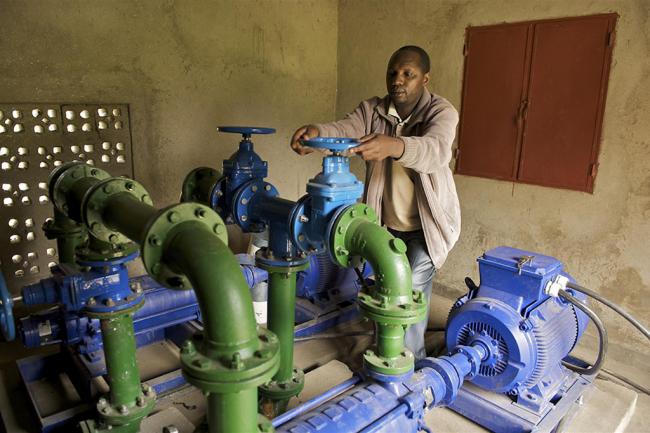
Bridging global infrastructure gap tops agenda at annual UN Partnership Forum
The theme of on Wednesday's Forum is Partnerships for promoting opportunities, increased prosperity and sustainable development for all. Since 2008, ECOSOC's Partnership Forum has brought together stakeholders, particularly from business and foundations, to discuss with governments ways in which to engage in support of the internationally agreed development goals.
In his welcoming remarks, ECOSOC President Frederick Musiiwa Makamure Shava, noted that infrastructure plays a vital role in economic and social development of cities, regions and nations. He also highlighted the importance of public-private initiatives in developing resilient infrastructure.
In the context of achieving sustainable development, in line with the Sustainable Development Goals (SDGs), he said there is a valid case to be made for infrastructure development and industrialization, as well as bolstering broad, multi-stakeholder partnerships in that regard.
“It is only through working together that we will be able to fully face and deal with the complexities of on Wednesday's development challenges which more often than not transcend borders in both their impacts and their solutions,” Shava said.
The geographic focus of on Wednesday's discussions is on infrastructure development in the countries facing the largest infrastructure gaps, such as those in Africa, the least developed countries (LDCs), landlocked developing countries (LLDCs) and small island developing States (SIDs).
“Not only does infrastructure improve access to agriculture, clean energy, education, water and sanitation, it also increases mobility, connects markets and helps create jobs,” Deputy Secretary-General Amina Mohammed said.
In a video message, the Deputy-Secretary-General called for the promotion of “effective” partnerships that emphasize “innovation, impact, transparency, coherence, accountability and sustainability.”
She said that the international community has a “once-in-a-generation opportunity” for peace, prosperity and dignity on a healthy planet – the aims of the 2030 Agenda – and “cannot afford to fail.”
Also speaking on Wednesday, the President of the General Assembly, Peter Thomson, urged the international community to “let go of old grievances and scepticism and called for “new and inclusive ways of thinking, partnering, financing, and delivering on the ground.”
In the coming months, high-level events on SDG action will be held, including a financing lab on 18 April, an event on innovation and connectivity on 17 May, and on education on 28 June. The Ocean Conference will be held from 5-9 June.
'Climate change is incompatible with poverty eradication' – Mary Robinson
In her keynote address, Mary Robinson, who spoke on climate justice as the President of the Mary Robinson Foundation, called for removing silos between governments, civil society and the private sector.
“Uncontrolled climate change is incompatible with the eradication of poverty,” Robinson said, underscoring the need for collective action. “And achievement of climate goals including access to sustainable energy for all is a driver of development.”
She called climate justice “the antithesis of the short termism that is on Wednesday causing nations to choose protectionism over international cooperation.”
“Our future security and prosperity depends not on the strength of our borders or the size of our armies, but on the depth of our education systems and the extent of global access to water, food and electricity,” said Robinson.
She noted, however, that not all action which is good for the planet is automatically good for people, and stressed the importance of human rights in all climate action actions.
Robinson, a former UN High Commissioner for Human Rights and a current member of The Elders, began her address by reiterating concern and moral outrage about the famines in parts of Africa and the Middle East. She also expressed concern about the purported chemical weapon attack in Syria calling it “a war crime and a crime against humanity.”
Photo: UNICEF/ Noorani
Source: www.justearthnews.com
Support Our Journalism
We cannot do without you.. your contribution supports unbiased journalism
IBNS is not driven by any ism- not wokeism, not racism, not skewed secularism, not hyper right-wing or left liberal ideals, nor by any hardline religious beliefs or hyper nationalism. We want to serve you good old objective news, as they are. We do not judge or preach. We let people decide for themselves. We only try to present factual and well-sourced news.
Support objective journalism for a small contribution.


