


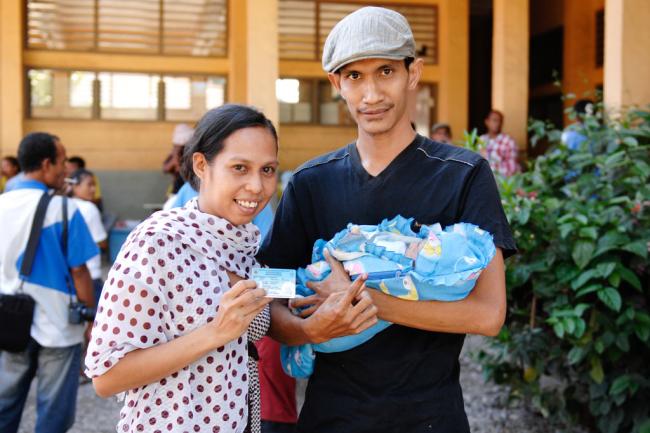
Ban spotlights need for gender equality, children's rights
The UN chief added that equitable social and economic development depends on fair legal frameworks that support the rights of women and children.
“Discriminatory laws and practices that do not give equal rights to all, and that suppress women's and children's rights, have no place in contemporary families, communities, societies and nations,” Ban said in a statement.
Discrimination and neglect often leads to violence, threatening women's and children's health and limiting their chances to complete education and fulfil their potential.
This cycle tends to continue into the next generation, as children experiencing violence are more likely to resort to violence in their adult lives, he added.
“In too many countries, discrimination against women and disregard for children's rights remain built into family laws and Government policies, and prevailing social norms often condone and justify many discriminatory practices,” Ban said.
Marked worldwide on 15 May, the theme of this year's International Day of Families – “Men in Charge?” – highlights the importance of gender equality and children's rights in contemporary families as more and more women are recognized as equal partners and decision-makers.
“On this Day, let us resolve to change legal and social norms that support male control over women, reinforce discrimination and prevent the elimination of violence against vulnerable family members,” Ban said.
“As we shape a new sustainable development agenda and strive for a world of dignity for all, let us stand united for women's and children's rights in families and societies at large,” he emphasized.
The Day was proclaimed by the UN General Assembly in 1993, reflecting the importance the international community attaches to families.
The Day has also inspired a series of awareness-raising events, including national family days. In many countries, the occasion is an opportunity to highlight different areas of interest and importance to families.
Activities include workshops and conferences, radio and television programmes, newspaper articles and cultural programmes highlighting relevant themes.
Photo: UN Photo/Bernadino Soares
Support Our Journalism
We cannot do without you.. your contribution supports unbiased journalism
IBNS is not driven by any ism- not wokeism, not racism, not skewed secularism, not hyper right-wing or left liberal ideals, nor by any hardline religious beliefs or hyper nationalism. We want to serve you good old objective news, as they are. We do not judge or preach. We let people decide for themselves. We only try to present factual and well-sourced news.
Support objective journalism for a small contribution.


