


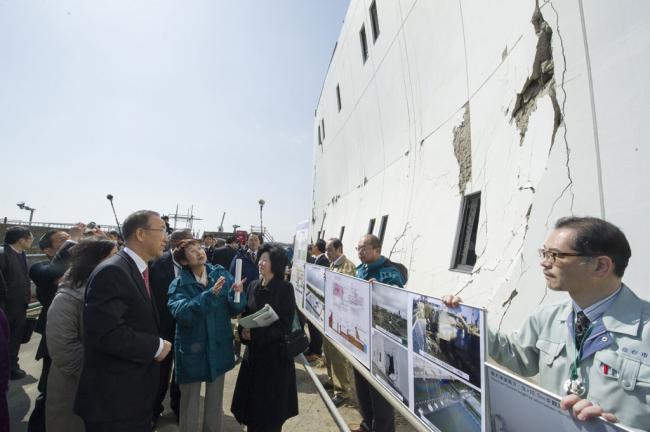
Ban praises Sendai earthquake recovery system
“Resilient recovery means protecting societies against the worst damage from future disasters. The money spent is not a cost – it is a valuable investment,” said Ban in remarks at a Tohoku University symposium, Lessons Learned from the Great East Japan Earthquake.
The UN chief is in the northern Japanese city attending the Third World Conference on Disaster Risk Reduction, which opened yesterday and wraps up on Wednesday, 18 March.
The meeting has drawn some 4,000 Government and civil society participants aiming to agree a new framework for managing disaster risk which will reduce mortality and curb economic losses.
Calling for a comprehensive approach that puts people first – especially the elderly, children, women, persons with disabilities, and others who are vulnerable, the Secretary-General said, “Success at the Sendai conference on disaster risk reduction will get this historic year off to the best possible start.”
Indeed, he said the United Nations sees 2015 as “a seminal year,” when the world body will aim to tackle twin priorities. One is crafting a post-2015 development agenda that would succeed the landmark Millennium Development Goals (MDGs).
He said, “We are now shaping the sustainable development agenda with a set of sustainable development goals.”
“Second, we have to agree on and adopt a universal, very meaningful, very strong, ambitious climate change agreement by December this year,” said the Secretary-General, explaining that crafting successful, effective and efficient disaster reduction mechanisms will help these twin priorities succeed.
“Therefore I am saying that sustainability, for which we are working very hard, starts in Sendai,” he declared, pointing out that allocating $6 billion for disaster risk reduction each year could bring up to $360 billion in savings by 2030.
He added, “If we invest one dollar today, then we can gain seven dollars by preparing against natural disasters.”
Ban carried that message, spotlighting the need to ensure 2015 is a year of transformative action towards sustainable development for all, throughout his visits today to some areas of Sendai impacted by the 2011 quake to view reconstruction and rehabilitation efforts, including the Minami-Gamo purification facility crippled by the 2001 earthquake and tsunami.
He also visited the Minami-Gamo Community Center and met community leaders and students and citizens, where he noted that four years ago, he had visited Minami High School [in Fukushima] and met many students at that time and had been very much inspired by their strong will to overcome and spirit and courage.
He said, “I am deeply impressed by the way the Japanese people have turned a tragedy into building back better their community."
“The United Nations World Conference on Disaster Risk Reduction…now being held in Sendai is exactly a demonstration of such spirit and visionary leadership of the Japanese Government and people to turn the tragedy into a better future, a sustainable future,” he declared.
He added, “The world and the United Nations support you. Keep doing your best.”
In his meetings today, Ban met with General Prayuth Chan-ocha, Prime Minister of Thailand, as well as with Fumio Kishida, Foreign Minister of Japan, and with King Mswati III of Swaziland.
Photo: UN Photo/Eskinder Debebe
Support Our Journalism
We cannot do without you.. your contribution supports unbiased journalism
IBNS is not driven by any ism- not wokeism, not racism, not skewed secularism, not hyper right-wing or left liberal ideals, nor by any hardline religious beliefs or hyper nationalism. We want to serve you good old objective news, as they are. We do not judge or preach. We let people decide for themselves. We only try to present factual and well-sourced news.
Support objective journalism for a small contribution.


