


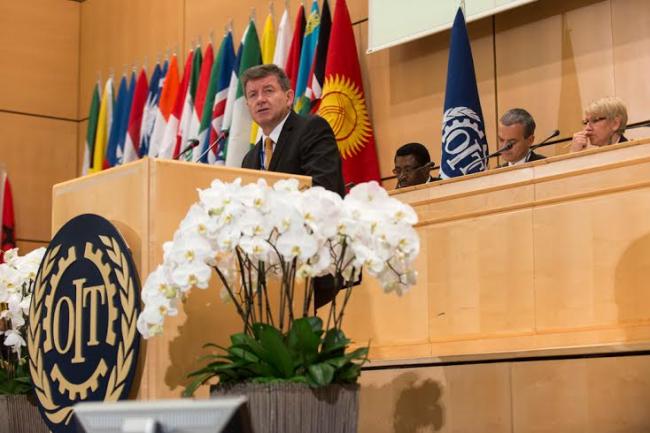
At Geneva jobs summit, UN labour chief urges a global debate on the future of work
“The issues of jobs, equity, sustainability, human security, labour mobility, social dialogue, which need to be tackled in a future of work initiative, are almost by definition the key policy issues of our time,” said ILO Director-General Guy Ryder at the start of the Conference, which runs from 1 to 13 June.
He also called on delegates to “look at the longer term drivers of change, the transformational mega-trends, and what they imply for the goals we pursue in the ILO in its second century.”
Mr. Ryder’s proposal is contained in his report to the Conference, The Future of work centenary initiative, and is accompanied by an annual report on the situation of workers in the occupied Arab territories.
The proposed initiative would be structured around four conversations: work and society; the organization of work and production; decent jobs for all; and the governance of work. Subsequently, a high-level commission on the future of work would prepare a report to the ILO’s centenary Conference in 2019.
“We have the opportunity to adopt a Recommendation which, for the first time, will provide an international framework for the transition from informality to the formal economy, which commands increasing tripartite support as a policy priority,” the Director-General said.
“We have the chance also to look more closely at how the small and medium-sized enterprises which are so crucial to the global jobs challenge can be promoted as creators of decent and productive employment,” he added.
According to the latest World Employment and Social Outlook report, global unemployment reached 201 million in 2014, over 30 million higher than before the start of the global crisis in 2008.
Moreover, providing jobs to the more than 40 million additional people who enter the global labour market every year is proving to be a daunting challenge. In addition to widespread joblessness, the employment relationship itself is facing a major transformation that is bringing further challenges.
This year’s Conference will discuss various other issues, including climate change, a proposed first ever international standard on the transition from the informal to the formal economy; the role of small and medium enterprises as a major job creation engine; and how to ensure labour protection (wages, working time, maternity protection and occupational safety and health).
High-level discussions on climate change and the world of work, as well as child labour will take place on 11 and 12 June, and there will be a focus on encouraging ratification by member States of the 2014 protocol to the ILO Convention on Forced Labour to enable it to enter into force.
Photo: ILO
Support Our Journalism
We cannot do without you.. your contribution supports unbiased journalism
IBNS is not driven by any ism- not wokeism, not racism, not skewed secularism, not hyper right-wing or left liberal ideals, nor by any hardline religious beliefs or hyper nationalism. We want to serve you good old objective news, as they are. We do not judge or preach. We let people decide for themselves. We only try to present factual and well-sourced news.
Support objective journalism for a small contribution.


