


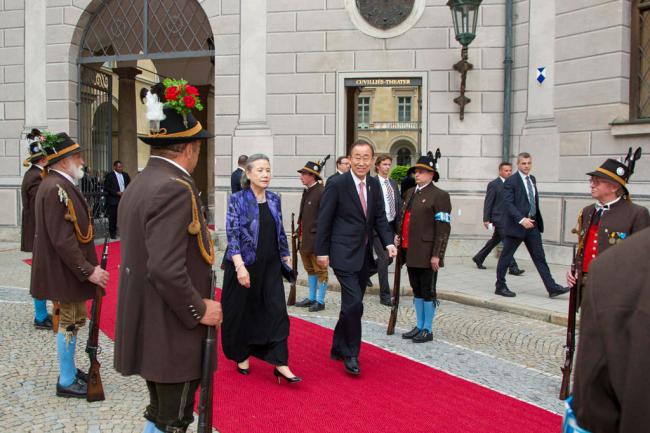
At G7 Summit, Ban outlines draft UN action plan to prevent violent extremism
“Missiles may kill terrorists. But I am convinced that good governance is what will kill terrorism,” Ban said in his remarks to a meeting on terrorism held during the Summit of the Group of Seven leading industrialized nations (G7) in Munich, Germany.
“During the last 15 years, most counter-terrorism efforts have been reactive, focusing largely on military and security measures. This approach has often generated negative unintended consequences, further radicalizing disenfranchised communities,” he stated.
For the UN chief, the two most pressing issues the international community needs to address are the underlying contexts and drivers of violent ideologies, and the main threats that have emerged, such as foreign terrorist fighters.
“From the deadly ideologies of ISIL and Boko Haram, to Islamophobia and anti-Semitism, this wave of intolerance and hatred is a serious threat to peace, development, human rights and humanitarian action,” Ban warned.
The UN Global Plan of Action to Prevent Violent Extremism, to be presented to the General Assembly later this year, will propose ways to address the causes of violent extremism, including intolerance, governance failures and political, economic and social marginalization. It will provide Member States with concrete recommendations for action at the local, national, regional and global levels.
“Addressing violent extremism demands a proactive, ‘all-of-society’ approach that includes minorities, women and youth as partners,” said Ban, noting that the targeting of women bears special mention. “With every attack and encroachment by violent extremists, the first targets are the rights of women and girls.”
Governments also have a particular responsibility to address the aspirations of youth, especially in countries where youth represent an increasing majority of the population, he added.
“Youth are the group most prone to radicalization and violent extremism. Most foreign terrorist fighters are young males aged between 15 and 35,” the Secretary-General pointed out. “But young people are also part of the solution to preventing violent extremism. We all need to do a better job of engaging them.”
Acknowledging that security measures and “even military action” may be necessary at times, Ban insisted on the fact that counter-terrorism efforts that ignore the rule of law and violate fundamental rights “not only betray the values they seek to uphold, but can also end up further fuelling violent extremism.”
While at the Summit, Ban also addressed a working luncheon for outreach partners, stressing the importance of this year in which Member States are discussing a new, universal development agenda for the next 15 years that will integrate the economic, social and environmental dimensions of sustainable development, and place poverty eradication at the core.
During a meeting with Angela Merkel, the Secretary-General thanked the German Chancellor for her country’s strong support for sustainable development, calling on it to continue its leadership role in delivering on the post-2015 agenda.
He also lauded Germany’s crucial role towards reaching a meaningful, universal agreement on climate change in Paris in December, and the two also discussed the importance of financing to meet the aspirations of the ambitious climate and sustainable development agendas, as well as the importance of global pandemic response preparedness.
UN Photo/Rick Bajornas
Support Our Journalism
We cannot do without you.. your contribution supports unbiased journalism
IBNS is not driven by any ism- not wokeism, not racism, not skewed secularism, not hyper right-wing or left liberal ideals, nor by any hardline religious beliefs or hyper nationalism. We want to serve you good old objective news, as they are. We do not judge or preach. We let people decide for themselves. We only try to present factual and well-sourced news.
Support objective journalism for a small contribution.


