


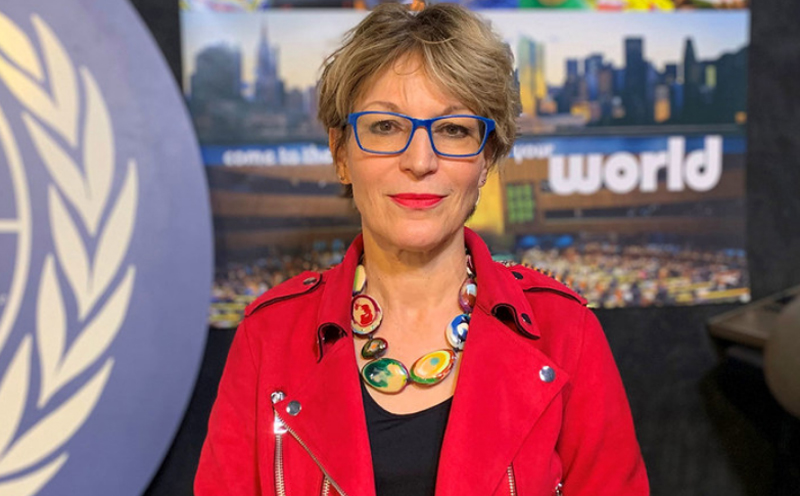
All drone strikes ‘in self-defence’ should go before Security Council, argues independent rights expert
New York: The growing use of weaponised drones risks destabilising global peace and security and creating a “drone power club” among nations, that face no effective accountability for deploying them as part of their “war on terror”, a senior UN-appointed independent rights expert said on Thursday.
At the UN Human Rights Council in Geneva, Agnes Callamard, Special Rapporteur on extrajudicial, summary or arbitrary executions, said that more than 100 countries have military drones and more than a third are thought to possess the largest and deadliest autonomous weapons.
‘No red lines’ in drone warfare?
States who used them on the grounds of self-defence, “defined in a very elastic fashion” against purported terrorists, risked creating a situation where “there will be no red lines really”, she told journalists later.
“As more Government and non-State actors acquire armed drones and use them for targeted killing, there is a clear danger that war will come to be seen as normal rather than the opposite of peace,” Ms. Callamard said. “War is at risk of being normalized as a necessary companion to peace, and not its opposite.”
Appealing for greater regulation of the weapons, and lending her support to calls for a UN-led forum to discuss the deployment of drones specifically, the Special Rapporteur insisted that their growing use increased the danger of a “global conflagration”.
‘Influential States’ rewriting the rules
Such a move was necessary because “a small number of rather influential States” had sought to reinterpret the law of self-defence under Article 51 of the UN Charter, she explained.
She urged UN Security Council to meet in formal session to review and debate all such self-defence claim, before recommending that the High Commissioner for Human Rights should produce an annual report on drone strikes casualties for the Human Rights Council.
There was now the “very real prospect that States may opt to ‘strategically’ eliminate high-ranking military officials outside the context of a ‘known’ war”, she explained, and that they might seek to justify the killing “on the grounds of necessity - not imminence” as the target was classified as a “terrorist who posed a potential, undefined, future threat”.
Iranian general’s chilling death
In particular, she cited the killing by drone strike in Iraq of Iranian General Qassem Soleimani on 3 January for which the United States claimed responsibility and which she insisted was a violation of the UN Charter.
“Targeted killings until very recently to drones had been limited to non-state actors,” she told journalists. Until, for the first time in January 2020, a State armed drone targeted a high-level official of a foreign State and did so on the territory of a third State.”
Drone strikes were the preferred option for “decision makers and military alike for their relative efficiency, effectiveness, adaptability, acceptability, deniability, and political gain”, the rights expert maintained.
But she noted that their benefits were as “illusory” as the “myth of a surgical strike”.
Because of the current absence of effective oversight, it was “practically impossible to know whether a person(s) killed in a drone strike was, in fact, a lawful target”, Ms. Callamard said, adding that harm to civilian populations, including deaths, injuries and trauma, was likely largely under-reported.
Khashoggi trial welcomed
Asked about the latest developments in the ongoing trial in Turkey into the killing of Jamal Khashoggi, the Saudi journalist who was assassinated and later dismembered in the Saudi Arabian consulate in Istanbul in 2018, the independent expert described the proceedings as “an important step”.
His killing had been “violent and extreme”, she said, adding that she hoped the trial might bring more elements to the story and increase the chances of accountability via an international probe.
Support Our Journalism
We cannot do without you.. your contribution supports unbiased journalism
IBNS is not driven by any ism- not wokeism, not racism, not skewed secularism, not hyper right-wing or left liberal ideals, nor by any hardline religious beliefs or hyper nationalism. We want to serve you good old objective news, as they are. We do not judge or preach. We let people decide for themselves. We only try to present factual and well-sourced news.
Support objective journalism for a small contribution.


